

TikTok has outlined some new age assurance measures that it’s deploying across Europe, as more EU nations consider higher social media age limits, while the platform has also provided details of its broader contribution to the EU economy, in order to showcase its benefits.
First off, on teen restrictions, TikTok says that, soon, it will roll out new measures to ensure that young teens are not accessing the app.
As per TikTok:
“In the coming weeks, we will begin to roll out enhanced technology in Europe to further support how our moderation teams detect and remove accounts that belong to someone under the age of 13. This follows an initial pilot in Europe over the last year, which led to the removal of thousands of additional underage accounts.”
So soon, TikTok will have more indicators to go on to determine user age, and address underage usage violations.
TikTok says that its updated age detection measures will factor in things like profile information, the videos that users publish, and other on-platform behavior.
“When our technology identifies that an account may belong to someone under 13, it will be reviewed by a specialist moderator who decides whether it should be banned. Like today, everyone has the opportunity to submit an appeal if they believe an error was made.”
When an error is made, TikTok says that it offers various options, including facial age estimation (powered by Yoti), credit card authorization and government-approved ID submission.
In combination, TikTok’s hoping that these enhanced measures will reduce the demand for higher age restrictions, with the EU Commission still weighing a potential increase in social media access, following the lead of Australia and its new teen social media laws.
I doubt that such measures will have a major effect, with French officials already considering a draft bill that would prevent under-15s from using social media, and discussions around the same ongoing in Spain, Italy, Greece and Germany.
Australia’s test case will be key to driving the next stage here (and Australian teens are still accessing social media at similar rates), but I’m not sure that there’s much the platforms themselves can do to reiterate their own standing.
On another front, TikTok has also shared some new insight into the platform’s overall contribution to the EU economy, with TikTok claiming to have driven €31 billion ($US36b) in economic value across the EU in 2025.
“This includes €7.2bn in economic output in Germany, €5.2bn in France, €3.6bn in Italy, €3 bn in Spain and €920 million in Poland.”
TikTok says that it now has more than 200 million users in Europe (a figure it first reported last September), who each come to the platform with a discovery mindset.
“That discovery helps businesses of all sizes turn audience attention into measurable outcomes, from interest through to purchase.”
TikTok says that it helped more than 6.5 million EU businesses grow across borders, while it also drove €13bn in economic growth for European SMBs in 2025.
TikTok also claims to have supported around 52k creative sector jobs in the region.
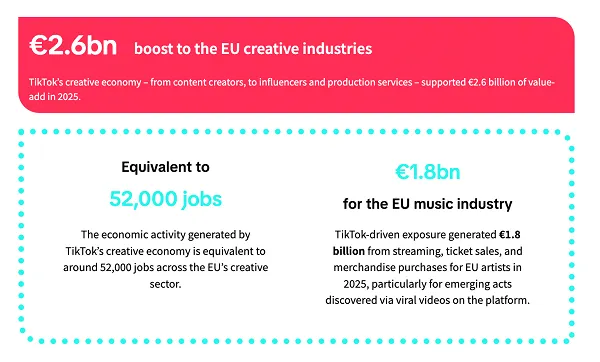
Some interesting stats, which, again, TikTok will be hoping will help to alleviate regulatory pressure, and ensure that EU officials recognize the value that it brings, aside from any other concerns.
Will that see the EU Commission ease its focus on TikTok?
Well, it’s probably a bit busy considering X’s non-consensual nudes of late, but eventually, you can bet that the EU team will re-focus on TikTok’s ills, and keep the pressure on, as always.
But at least they’ll be doing so with a little more context.
![The Rise of Gen AI Apps [Infographic]](https://i2.wp.com/imgproxy.divecdn.com/KWisL2a4mhGdffS2QbM_duRlB8G52cwbcLFdyI59gnM/g:ce/rs:fit:770:435/Z3M6Ly9kaXZlc2l0ZS1zdG9yYWdlL2RpdmVpbWFnZS9yaXNlX29mX2dlbl9haV8yLnBuZw==.webp?ssl=1 "The Rise of Gen AI Apps [Infographic]")
