

The white ON AIR light was still glowing when the cops walked in. A tiny bulb in a dirty old studio, shining on as if it had no idea its world was about to change. It was October 3, National College Radio Day. The one day meant to honor the weird, chaotic magic that stations like 89.3 WCSB were built on when Cleveland State University sent police officers to escort students from the airwaves they’d been broadcasting from for nearly half a century. No warning. No goodbye show. Within hours, the eclectic collage of punk, jazz, metal, and noise vanished from the dial, replaced by a neat, polished stream of 24/7 jazz as the university handed the signal over to Ideastream Public Media, Cleveland’s consolidated public broadcasting giant that runs the city’s NPR and PBS stations
This happened in Cleveland, of all places. The city where the words “rock and roll” were first transmitted across the airwaves and into the bloodstream of America, accidentally crowning this industrial pocket of the Midwest the Rock and Roll Capital of the world. This was a place where a strange new sound had a fighting chance if one DJ liked it enough. Now, it’s a place where a state-funded university quietly removed its own students from the airwaves. There was no emergency or misconduct requiring an officer in a doorway. Just a deliberate administrative decision, filtered through the lens of a nonsensical perspective that burying a half-century of music and counterculture is somehow good for its students and the community it served.
The person steering this decision was Cleveland State’s president, Dr. Laura Bloomberg, who was already talking up the partnership as something “built on opportunities for students” while she was breaking in her new seat on the board of trustees at Ideastream—a perk she may have been secretly negotiating for six months prior. Standing beside her was Ideastream CEO Kevin Martin and a stack of agreements: the eight-year Program Service and Operating Agreement, the Memorandum of Understanding, the promised promotional slots, and the hazy internship section with no real figures or numbers to substantiate any significant student involvement. It all amounted to a slow, polite gaslighting, suggesting that dismantling a space where students and community members could experiment, screw up, and find their voices organically would somehow elevate them by turning them into interns on someone else’s tidy, polished jazz show.
That polish is part of the problem. WCSB wasn’t polished. It didn’t want to be. It existed in a scrappy, self-sustaining corner of the dial where the fringe came to breathe. It survived the death and resurrection of record stores, the collapse of alt-weeklies, the rise of streaming, and wave after wave of administrative turnover. But the university didn’t seem to care about that ecosystem. And the internal communications plan later obtained through public records, shows exactly how shallow their understanding was. Administrators rehearsed who to call—the mayor, local philanthropists, heritage program hosts, but nowhere in those pages was there a strategy for backlash. Nowhere did anyone seem aware that removing a beloved cultural institution at 11:00 am on College Radio Day might make people furious. They planned for logistics. They did not plan for consequences. The act itself was soulless, full of bureaucratic euphemisms that flatten creative spaces into bullet points and treat culture like fast food.
They treated it like excess inventory, never once considering what happened inside that studio. A studio that housed hundreds of thousands of records, CDs, and cassettes—one of the largest physical music archives in the region; now sealed away in silence. Decades of donations and rarities carefully cataloged by generations of programmers. It was built for the insomniac searching for something real at 2:00 am, for local weirdos and comedians using the airwaves like a pressure valve no commercial station would ever allow, and most importantly, for students, it was a petri dish. A place where someone who had never felt they belonged suddenly discovered they had a voice, and they can fail over and over again with very low stakes until they figured out how to be on air. It cannot be replaced by an internship or corporate programming. College radio DJs gave us R.E.M., the Replacements, and Sleater-Kinney; corporate programming gave us Kenny G.
That’s the ecosystem Dr. Bloomberg traded for.
They probably expected a few weeks of anger, maybe a petition and a protest before everyone went home and forgot about the whole thing.
Instead, they got Alison Bomgardner.
Bomgardner, WCSB’s last student general manager, refused to call it a funeral. She rallied programmers, DJs, engineers, community members, alumni, and anyone else who refused to let the signal’s death be written as a footnote. They rebranded themselves as XCSB, organized protests, flooded meetings, and kept telling the story long after the administration assumed everyone would go quiet. But WCSB didn’t go away quietly because the people who ran it wouldn’t let it. They pushed through discomfort and continued to irritate the institution that was supposed to look out for them, but cast them aside instead. So, they committed to the idea that if the institution wanted to forget them, they needed to become unforgettable.
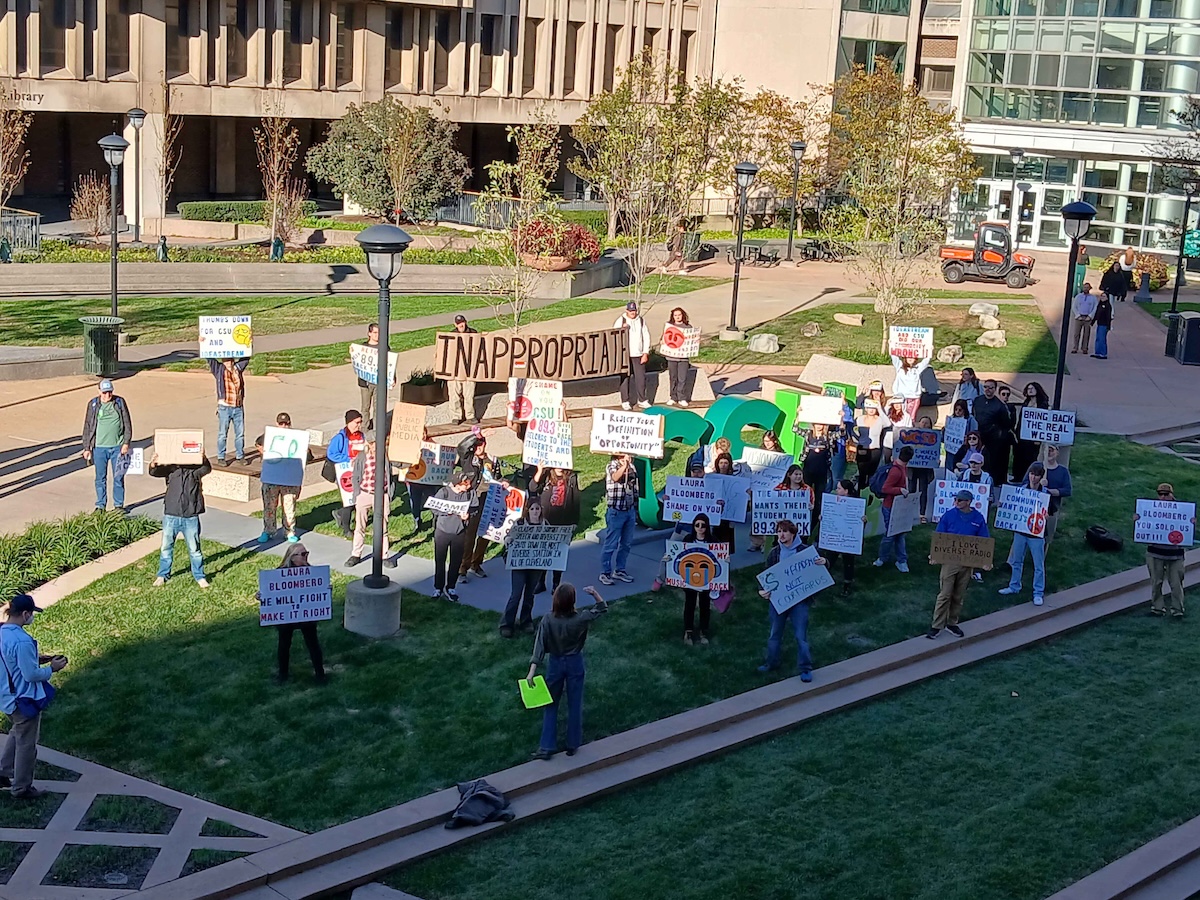
The backlash hasn’t been small. Students have been protesting all over campus, alumni are writing furious letters, and even the Cleveland City Council demanded CSU reverse the move while international-language hosts publicly mourned their loss of platform. On Wednesday, November 12 the Cuyahoga Arts & Culture board meeting was overtaken by speakers furious at Ideastream’s role, with some people demanding the organization’s public funding be withheld until the station’s original programming was restored back to the students.
The administration assumed things would quiet down, but they inadvertently created a monster that plans to be a thorn in their side for a long, long time. Maybe the students get their signal back, maybe they don’t, but what is certain is that they will be a constant reminder to everyone involved in this that they did wrong, and they’re not going to hear the end of it as long as 24/7 jazz occupies their signal.
That’s what other universities with beloved stations and communities should be paying attention to. Not every college station has a coalition willing to fight like this long after the microphones have been unplugged. This isn’t happening in a vacuum. This is part of a growing national trend: universities quietly folding student-run stations into larger public-media networks, often justifying it with budget stress or “streamlining.” WCSB didn’t just get caught in a local administrative reshuffle; it got swept into a broader pattern where university leaders treat student-built cultural institutions as expendable line items rather than public goods.
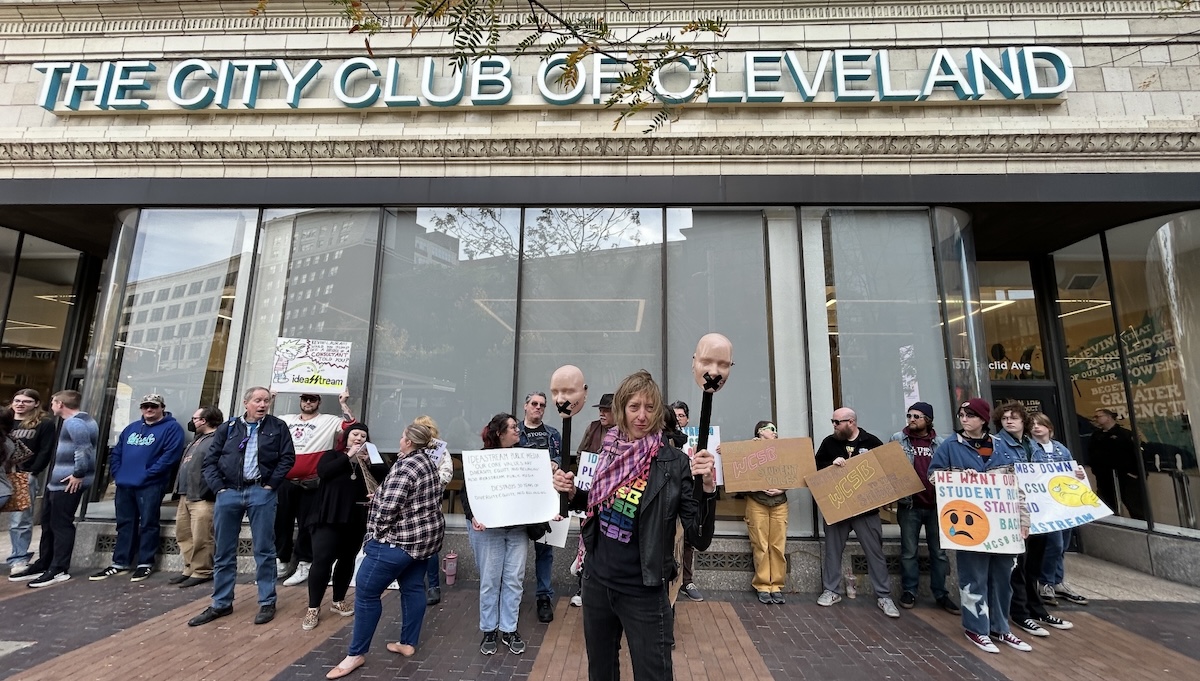
WCSB is gone, at least for now, but XCSB remains. Not as a consolation prize, but as a physical manifestation of defiance and creative coalition dedicated to preserving WCSB’s mission of harboring and fostering creative spaces, but also as a reminder that culture doesn’t vanish because a contract says it should. Institutions will try to neutralize what they don’t understand, but the people shaped by that culture have longer memories than the administrators who signed something away that never belonged to them in the first place.
College radio gave us decades of great music, but Alison Bomgardner and the XCSB collective are showing us that silence is something you push back against. That white ON AIR light is still on, and if Cleveland State and Ideastream honestly thought this would all go away quietly, then that proves they never listened to 89.3 WCSB.

