

“Anybody could be ‘Ballgame,’ says Tyler Ballgame. “You could be ‘Charles Ballgame.’” The singer-songwriter is referring to baseball great Ted Williams, who earned the nickname “Teddy Ballgame” for his unparalleled talent and unrelenting passion for the sport; a figure Ballgame admires and ultimately took inspiration from.
Ballgame is in Brooklyn for a show at the small neighborhood bar, Union Pool, which ironically, has neither billiards tables nor a swimming pool.
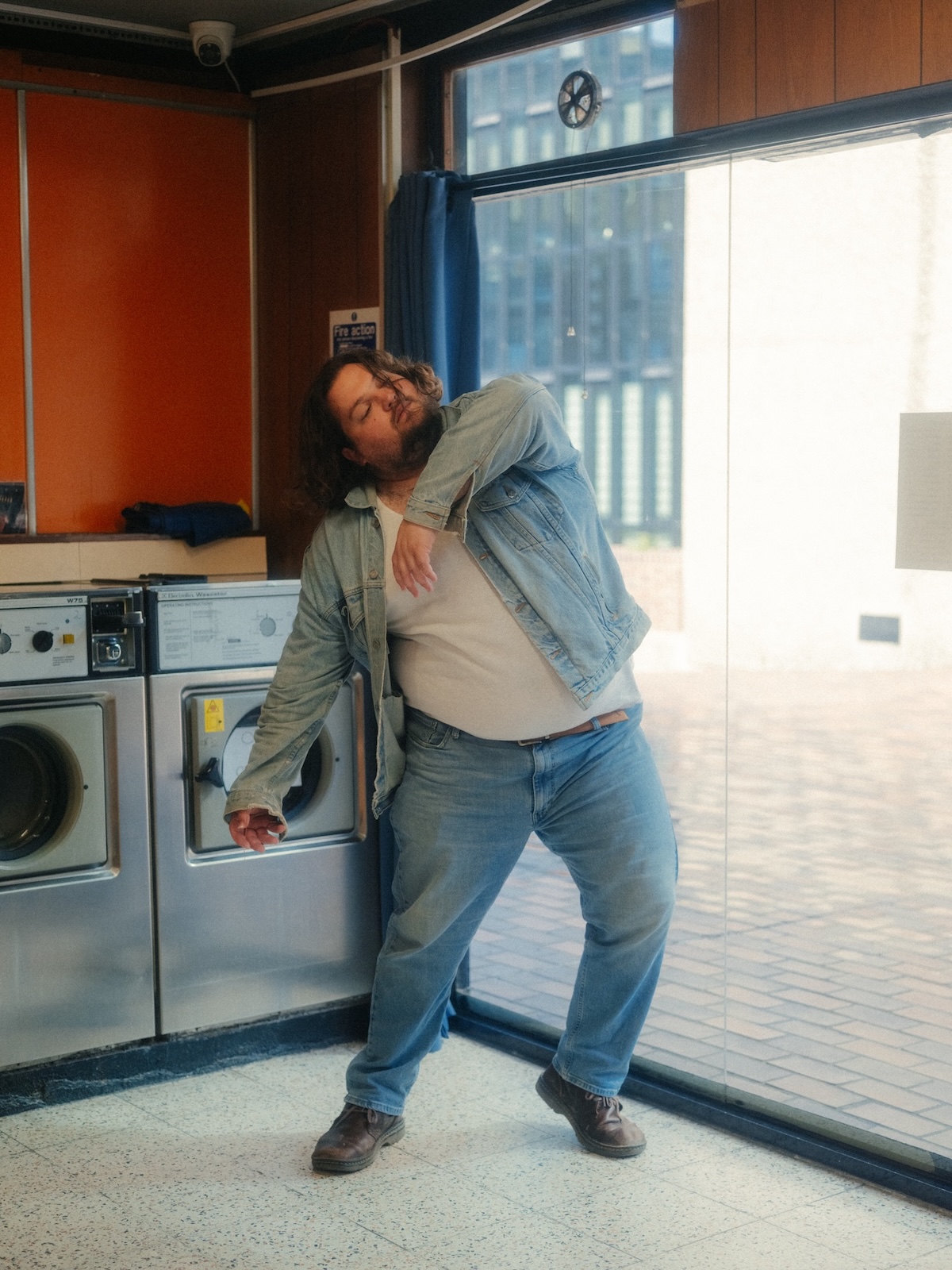
He’s wearing a white knitted sweater, his shoulder-length brown hair tucked behind his ears, and a scruffy beard. He’s soft-spoken and shy, unexpected for the big bear of a man that he is. Equally unexpected is his soulful tenor singing voice, which critics have likened to a cross between Roy Orbison and Elvis Presley.
But it was the album, Nilsson Sings Newman, an all-time favorite of his, that Ballgame says taught him how to croon with such warm and earnest vulnerability.
“When I first discovered it, I was like, oh, finally a real singer singing Randy Newman songs,” he says. “And as I got older and listened to more Randy Newman, Randy’s the better singer, because he makes you feel more than Harry Nilsson. Nillson is an incredible singer. He makes you feel a ton. But his voice is so perfect, it’s almost unrelatable. Randy Newman’s voice makes me feel so much of the ugliness of the characters in his songs; that’s real singing.”
It’s no surprise then, that Ballgame elicits a similar response from his ever-growing fanbase when hearing him perform, particularly at his live shows, where his knack for connecting with his audiences on such an intimate level has put him on a career trajectory to stardom.
Before he found success as a musician, he was Tyler Perry, a Berklee College of Music dropout living in his mother’s basement in Rhode Island during the COVID pandemic.
He counts The Beatles, The Who, and Jim Croce as some of his earliest musical influences, but it was when he saw Fleet Foxes perform “Mykonos” on “Saturday Night Live” while at a sleepover in 2009 that he says made him realize he wanted to play music for a living.
“It changed something within me,” he says.
Between playing cover gigs, he worked at his stepfather’s dog-training business and wrote songs, chronicling his failing music journey. His Tyler Ballgame persona started out as an ironic character in one of those songs, “Got a New Car,” the first single off his upcoming debut album, For the First Time, Again, out January 30.
“It was kind of like a little joke at myself, like, ‘Tyler Ballgame got his hopes up, you know, that it would actually work out for him,” he says, quoting the lyrics.
Ballgame admits that he was in a pretty deep depression for the entirety of his 20s, and smoked a lot of weed. He tells me he’d wake up in the morning, get high until he eventually dozed off, then wake up and do it over and over again until it was bedtime.
He says that during his childhood, he was lauded and praised for his singing voice, for having a true musical gift. His family had high expectations that he would do something special with his talents. Instead, he quit college and moved back home.
“I think a lot of it was just weighing the weight of expectation around being a gifted child,” he says. ‘That gifted-child-to-depressed-adult pipeline is very real. It was just a lot of sitting around feeling sorry for myself and trying to wrestle the illusion of the mantle of control via self-sabotage. I wasn’t who I was supposed to be. Like, I was this artist that would never find an audience, and that would never be able to make art and would have to be a square peg in a round hole…get a regular job and be a regular person.”
At the urging of his mother, Ballgame began seeing a therapist, a nutritionist named Courtney Huard who became an important mentor for him during his recovery. She worked with him through the lens of Ballgame’s unhealthy relationship to food and body image, among his other patterns of self-abuse. He also found inspiration to change from the teachings of philosophers Eckhart Tolle and Alan Watts.
“I kind of had the wool pulled from my eyes around the nature of ego and human suffering,” he says. “I was like, oh shit! I’m just one flavor of how a brain is either in order or disorder. And all the space between it freed me from the association of that. And then you realize the only thing that’s real is the right now, the present moment. And so much of our suffering and tension in our lives is not being able to square with expectations for the future or dwelling on things from the past. And both of those things are not real and don’t exist anywhere in reality.”
On a whim, he applied for a commercial real estate job in Los Angeles, lying about the fact that he had no degree and no experience. He was hired, and within two weeks, with support from his family and Huard, he moved across the country to Venice Beach.
Viewing his move as a new lease on life, armed with his acoustic guitar and a renewed sense of self-confidence, Ballgame began performing his own songs at open mics, eventually forming a band. As he explored names for his new project, he started reading through some old lyrics he had written back in Rhode Island. He came across “Got a New Car.” But this time, the meaning of Tyler Ballgame, he realized, was different. Rather than a joke, it was aspirational.
“Ballgame is a character, it’s a mask that I wear to be able to be bold on stage and be the archetypal front man, and occupy this space where I can end up showing more of myself…it’s the blank canvas that gives me the license to free myself from the shackles of Tyler and be Ballgame,” he says. “It’s just been really freeing.”
After a year of playing to increasingly larger audiences, Ballgame met acclaimed indie musician-producers Jonathan Rado (Foxygen, The Lemon Twigs, Weyes Blood) and Ryan Pollie (Los Angeles Police Department), who urged him to make an album. Over the next few weeks, Ballgame and Rado recorded more than an album’s worth of his original songs.
Around this same time, Ballgame learned about the death of his former counselor, Huard, back in Rhode Island, the victim of a murder-suicide by her husband.
“People come in and out of your life and are there for a really important time,” he says. “I now see myself and my journey as a branch off of her legacy, her life’s work, and what she stood for and the points she chose to push at and use her life force and energy towards. I’m now within that heritage, and that means a lot to me.”
Many of the songs Ballgame and Rado recorded make up For the First Time, Again. The 12 tracks are rooted in classic rock, indie, and Americana.
On “You’re Not My Baby Tonight,” Ballgame channels the late Roy Orbison as he croons, “Well, I knew you once / I know you now,” his voice flowing from conversational whisper to full-throated soaring, “I’ve known you forever / Can’t wait to meet you for the first time again.”
Ballgame lets loose on “Matter of Taste,” which is one of the best tracks on the album, as he growls and whoops with exuberant confidence about wanting love but not necessarily needing it.
But it’s “Goodbye My Love,” that Ballgame considers really special.
“I remember hearing it for the first time,” he says. “Rado sent it to me the night that we made it, and I got really scared actually, because it was the first thing that I’d ever been a part of that I thought was objectively great and was objectively compelling on a level where it felt like, oh, that could change my life.”
Ballgame attributes his former counselor, Huard, as part of the inspiration for writing the album. “Even though the person’s gone, all that love that builds, all the firmament of who we are and how we relate to each other can never go anywhere,” he says. “It’s just in another face. It’s just in another form. And that’s been really foundational to writing this record and just how I view my role as an artist, and helps me be strong and bold.”
Reflecting on his darker days, back before he found success, living in his mother’s basement, depressed and rudderless, Ballgame doesn’t regret the poor choices he made back then. “I’m actually very grateful for that space because it made me who I am now,” he says. “I think my unique perspective, having kind of taken those lumps, is actually more valuable to the world than just being a gifted snot-nose kid, you know?”

