

Real-time online music sessions are here, and they’re starting to have an impact. Musicians of all levels are flocking towards the efficient proposition of doing much of their work online.
Music lessons, group rehearsals, onboarding new band members, and even entire band reunions are taking place entirely online using technology that makes it feel like you’re playing with other musicians in the same room, even if you’re hundreds of miles apart. While we are still learning the full scope of its uses, one thing is crystal clear about the new online music collaboration platform, Lutefish, and it’s that it definitely works. Check out this SPIN-facilitated demo video for some hard proof.
More Authentic Online Lessons
Music education has been taking advantage of the internet for decades, but only now is that partnership reaching its full potential. Current music educator and former Sugar Ray bassist and songwriter, Murphy Karges, has had a thorough music career. And now, after decades of touring, releasing albums, and working on megahits like “Fly,” Murphy now runs an elite bass education program, one that’s mostly online.
Despite being primarily remote, Murphy’s program isn’t your typical stack of prerecorded video content. Rather, it’s designed as a personable teaching experience, where he’s there to provide direct instruction and feedback to his students. But that kind of real-time interaction is difficult to pull off using typical video call apps.
“You can show somebody something over Zoom and it’s a bit detached,” explains Murphy, “but for some things it will work.”
Desiring better results, Murphy searched for something meant for music, not business meetings or video calls. For musicians to play together online, you need a connection that is much faster and more responsive than an app like Zoom. Those platforms are fine for chatting because you don’t need a super-fast connection to keep a conversation flowing, but real-time musical collaboration is different. Even slight delays can result in disastrous sync issues with musicians becoming completely disoriented.
Murphy chose Lutefish, a made-for-music remote platform that achieves faster speeds by using a hardware device that acts as a bridge between a musician’s instrument and the internet.
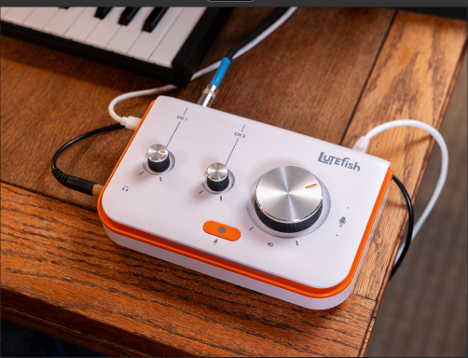
“I chose it (Lutefish) because it’s a simpler model than the others. Some of the other ones don’t even have a physical device. I looked at them all. And some look sketchy, like a hacker’s website. Lutefish is a tangible physical device you use, and you plug in, it sits on your desk, and it’s fairly simple to operate.”
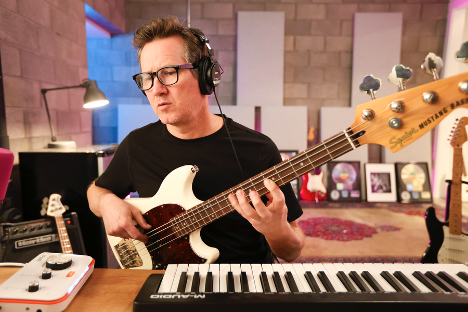
Lutefish’s responsive connection keeps up with a group of musicians playing in real-time. It also delivers better audio quality with two high-quality inputs for instruments and mics. The clear audio and fast connection create a convincing experience, according to Murphy.
“My students and members feel like I’m sitting right next to them, in the room, going over the exact thing they need… either right or wrong, in real time.”
A Busy Band’s Dream
Working bands are also benefiting from real-time remote sessions. Up-and-coming SoCal thrashers Trip To The Morgue have been experiencing challenging, but welcome, growing pains over the last year, with a new record deal and a rigorous touring schedule. When the band needed to add a new guitarist in the middle of the chaos, remote rehearsals saved the day.
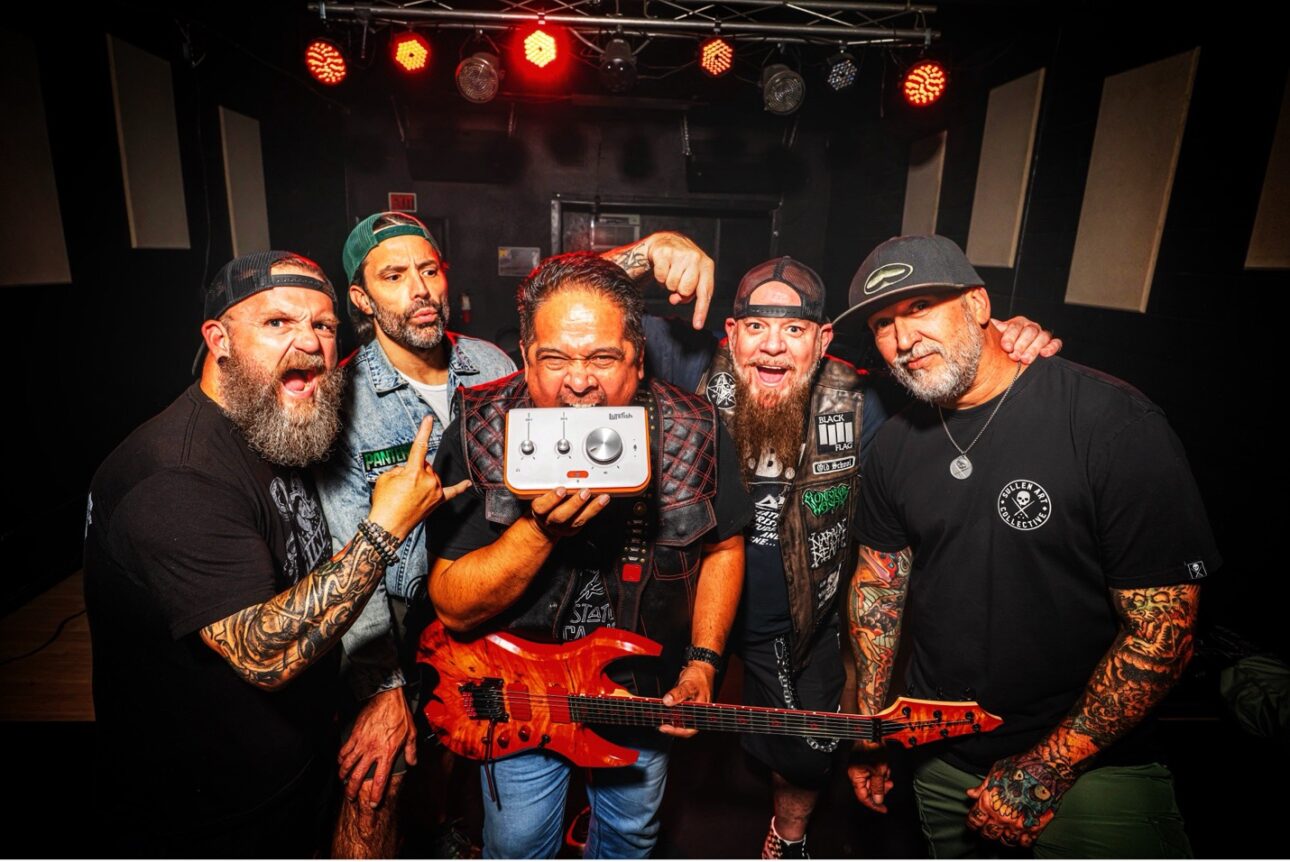
When describing the onboarding of new band member, Jamison “JJ” Jackson, who lived hundreds of miles away, Trip To The Morgue guitarist, James Patrick McCosar, explains that they were actually able to practice as a band via Lutefish. Three weeks later, Jackson actually played a live gig with them in Las Vegas. Via remote rehearsals with Lutefish, Jamison was ready for the stage in less than a month.
“Let’s be honest, making it in the music business nowadays requires bands to be tight, sound cohesive, and play like you’ve been together for years,” asserts McCosar. “Lutefish is like a shortcut. You skip travel time, random practice room challenges, and scheduling nightmares. With Lutefish, the only limitation is your time and dedication.”
Getting the Band Back Together
Lutefish’s online music rehearsals and lessons are making it easier for music educators and bands to squeeze in sessions. In fact, some projects on Lutefish would not even be possible without it.
Scott Walker wanted to reunite his college band for a show to celebrate his retirement, but Scott knew they would need more than a few rehearsals after nearly four decades of not playing together. With the group now separated by hundreds of miles across Florida and the Carolinas, in-person rehearsals were not feasible, so Scott turned to Lutefish.
“Without Lutefish, we couldn’t have pulled this off,” he recalls. “We only had time for a few in-person practices, but we could rehearse weekly online. We’d jump on between the end of the workday and supper with short, focused sessions. Those weekly jam sessions were the difference between being ready and not. The show went off without a hitch, and the group sounded good. And not just “good for garage band,” but more like, “why did these guys ever stop” good.
“Being able to actually play music together in real time was the game-changer,” Scott adds. “The Lutefish network makes latency tolerable, and the experience forces you to simulate a real performance by standing, playing, singing, and managing sounds. It’s the next best thing to being in the same room.”
The Challenges of Remote Music Platforms
With such obvious benefits, why is remote music collaboration just starting to catch on, when we’ve had Zoom and FaceTime for ages? Why did it take so long for music to hop on the remote collab bandwagon? The answer is internet latency.
Based on prior research, it’s generally accepted that for a functional and enjoyable online music session, musicians need to hear each other’s notes and rhythms within about 40 milliseconds of their occurrence. That means from the time a guitarist plucks a string, you only have 40 one-thousandths of a second to get that sound through an audio input, an analog-to-digital audio converter, a home router, miles of networking cable, and then through another router and audio converter on the other end.
Until relatively recently, the average internet connection did not provide a latency level that was consistently low enough for real-time music collaboration. But today, according to the FCC’s most recent available data, the average latency of a fiber internet ISP sits somewhere around 10 milliseconds, and a cable ISP is around 18 milliseconds, providing enough headroom for online music rehearsals that feel natural. Keep in mind, an average network latency of, say, 39 milliseconds still would not be fast enough for online music collaboration because network latency is just one part of the process. It also takes a non-negligible amount of time to convert sound to and from the digital realm and to get it through a pair of speakers. That’s why you need an average latency that is well below the 40-millisecond max.
Once low latency became a widespread reality, it took someone with the right resources and motivation to create an online music platform. That’s exactly what happened for music manufacturer, Wenger Corporation, when, during the pandemic, it realized the technology, infrastructure, and market were primed for a remote music collaboration solution, and Lutefish was born.
Being backed by an industry staple like Wenger is a huge security net for a new platform like Lutefish, which debuted in November 2024. With any product that requires consistent updates and support to remain highly functional, it’s important to choose a solution that’s going to stick around. That’s what sets Lutefish above the competition – it’s built on an 80-year foundation of the heavily trusted music giant Wenger Corporation.
Lutefish may be the edge the music industry has desired for decades. It works well, sounds good, and feels a lot like playing music with someone in the same room, despite working up to 500 miles away. It’s easy to see a future where musicians utilize remote sessions the way that other industries have leveraged remote collaboration for years. It’s simply too efficient, cost-effective, and beneficial to pass up. It’s great to see those advantages finally taking shape for musicians.

