

“Sometimes I wish I didn’t feel so much,” says Mon Laferte. “On a normal day, I probably find myself crying 10 different times. I wake up, walk into my garden, and suddenly I feel everything: the sky, the clouds, a butterfly. I find beauty even in a garbage dump. I start making up stories: who threw that empty bottle? What was he thinking about when he drank from it? I’m always romanticizing things. And now that I have a baby boy, my sense of wonder has increased because I get to see reality through his eyes.”
It’s a lovely sunlit afternoon in Tepoztlán, one hour away from Mexico City, the place that the iconic Chilean chanteuse calls home now that she’s an international star—one of the most prestigious artists in Sony’s Latin roster. Through the Zoom connection, I see her smiling, surrounded by windows and vegetation. At 42, Laferte looks stunning wearing a dark cap and rose-colored lipstick, a spider tattoo on her neck, her thin wavy eyebrows the epitome of elegance. There is a faint glimmer of sadness in her eyes as she speaks in Spanish about the exhausting intensity that informs her days.
“I take a lot of pills,” she says. “Not too long ago, I was diagnosed with bipolar disorder. The pills have compressed my tendency to feel, but they help me focus. I still live my life intensely. The medicine helps me realign those forces. Things are a bit more orderly now.”
Connecting a mood disorder with exceptional artistic acumen is far from revelatory, but Laferte’s latest album is the perfect example of a phenomenally gifted woman who turns her obsessions and psychological wounds into artifacts of unfathomable beauty.
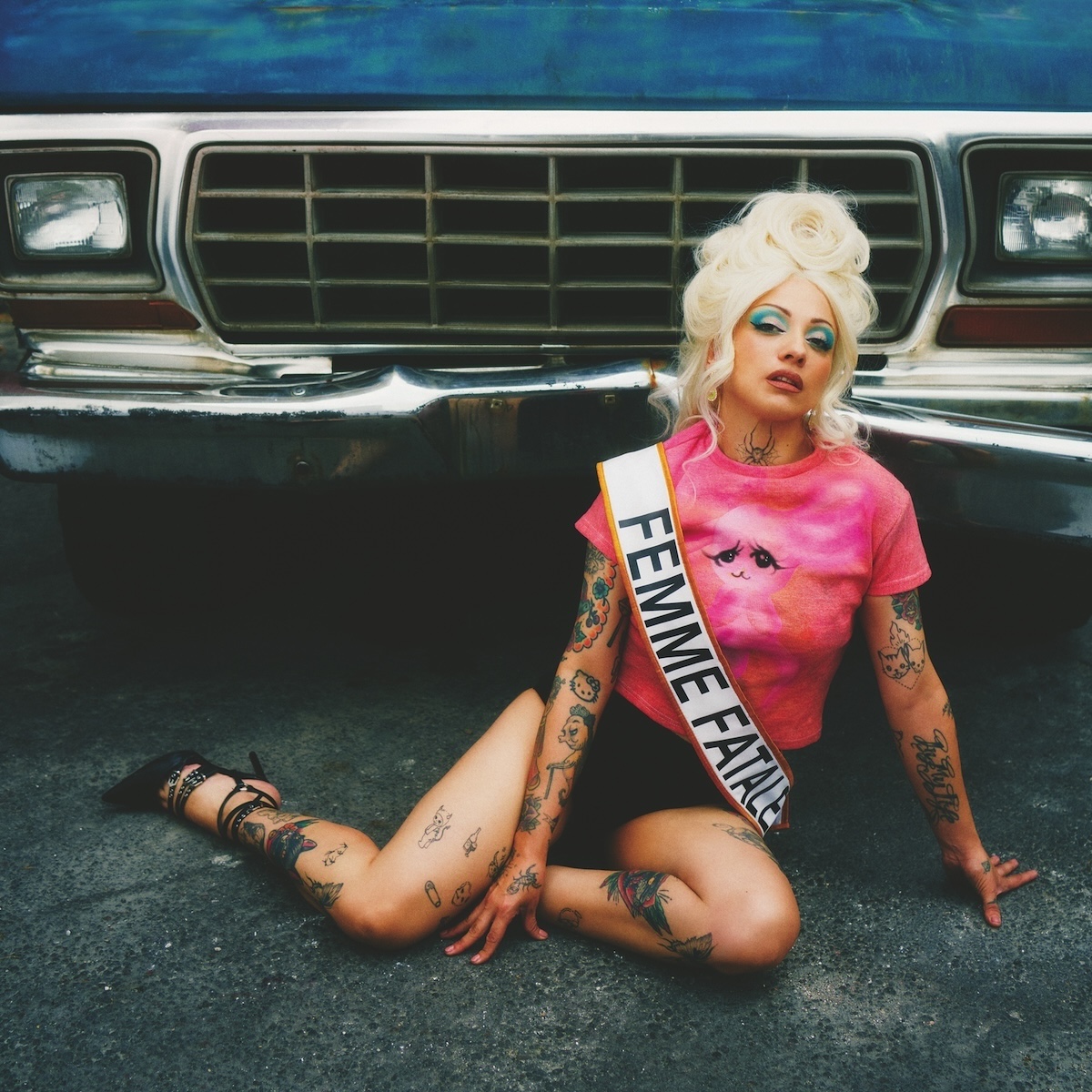
Titled Femme Fatale, her tenth LP is a bonfire of melodrama—a gothic concept album in garish technicolor that fuses the torch song aesthetic of ’50s jazz with the gravitas of orchestral bolero, tawdry South American balada, a touch of Boris Vian decadence, and a dash of trip hop noir.
She has also taken a few steps in the direction of mainstream success. The engineering and production standards on Femme Fatale are top notch, and the album includes high-profile features by like-minded divas Nathy Peluso, Silvana Estrada and Natalia Lafourcade.
Strangely, the collaborations—including one with Argentine pop-rock sensation Conociendo Rusia—pale in comparison to the solo tracks. Her voice is volcanic, occasionally berserk, but also soothing and intimate at the right moments. Until she broke through in 2015 with her majestic fourth album, Mon Laferte, Vol. 1, there simply wasn’t another artist like her in Latin music—a cosmopolitan mashup of La Lupe and Lana del Rey.
“She’s such a force of nature,” says Chilean guitarist Sebastián Aracena, a frequent collaborator. “Absolutely indomitable. Work with her, and you have to surrender to the process. On this album, which is highly autobiographical, she tried to handle most of the process herself. She addresses the father who abandoned her, and the instances of sexual abuse that she suffered. Working with her is an organic experience. She’ll give me some notes, describe the sound that she wants, I’ll start playing, we’ll do a loop, and she sings the melody on top.”
“I’ve learned to find pleasure and poetry in absolutely everything, and there’s a danger in that,” adds Laferte. “I may be deep inside the shittiest situation, and I start saying to myself: I could turn this into gold, like an alchemist. I could transform the pain into music and laugh at it, look at it from the outside like you would a beautiful painting. I could even get to enjoy this. I’m no masochist, but my artistic persona can spot an opportunity in the crisis.”
She has also made waves by her unflinching depiction of sexuality, daring to focus on the kind of raw intimate details that make most people uncomfortable. On the slyly titled “Mi Hombre” (My Man), she describes with glee a toxic relationship involving a lover who sleeps with three other women when he’s not gaslighting or beating her up. The backdrop is all Blue Velvet perversion: Aracena’s lacerating electric guitar set against a bed of brushed drums while Laferte luxuriates in her own singing.
On “Las Flores Que Dejaste En La Mesa”—probably the record’s most devastating track—she imagines her ex having sex with other people before suddenly interpolating: “sometimes you remind me of my father.”
“Thinking offers the ultimate degree of freedom,” she laughs. “I remember being mad at my mother when I was young, and deciding to cuss at her in my mind, enjoying the fact that she would never find out. I like being mischievous with my lyrics. I love writing the things that we think about but are never bold to vocalize. I imagine people listening to my songs and blushing a little, or deciding not to play to them when other people are present, because it would feel too awkward.”
It is the music, of course, that amps up the extreme nature of her lyrics. And Laferte is definitely a highly educated listener. On the title track, she sings a line (“llevo el caos de promesa con mis labios”), phrasing it just like Billie Holiday would—a conscious tribute. “La Tirana,” her duet with Nathy Peluso, is a brand new song, but it brings to mind the Tite Curet Alonso bolero of the same name made famous by Cuban powerhouse La Lupe in 1968. And the sultry spirit of “Cry Me A River” hitmaker Julie London permeates the album’s jazzier moments.
I ask her when it was that she discovered the lush terrain of James Bond movie themes and Peggy Lee torch ballads.
“I grew up listening to music that was heavy on drama, like Edith Piaf and Lola Flores,” she recalls. “I remember there was a radio show on Sundays, and my Mom would record it on her cassette deck. That’s how I got into Julie London and Brenda Lee. Their stuff was romantic and contemplative, but at the same time you had these powerful females with fire in their voice. Later I listened to everything, from Juan Gabriel to Radiohead.”
Laferte will spend most of 2026 touring the songs of Femme Fatale in the U.S. and Latin America. But don’t expect her to spend any time resting on her laurels.
“I don’t give myself the freedom to sit down and enjoy my accomplishments,” she says. “I get a little stuck on the quality of the work. I don’t know exactly how I’m going to do this, but I expect my next record to be much better than this one.”