

Pigeons Playing Ping Pong is a unique star, a bright constellation within the multiverse of jam bands. This Maryland-bred quartet fuses funk, rock, and electrifying showmanship into what they call “high-energy psychedelic funk.”
Since forming in 2009 at the University of Maryland, they’ve built a devoted following through relentless touring (as many as 200 shows a year) and electrifying performances where kaleidoscopic improvisation reigns supreme and no two shows are ever alike.
While their contemporaries might lean into either pure funk or sprawling psychedelia, Pigeons threads the needle, creating dance-worthy ear worms that can spiral into 20-minute face-melting, cosmic portals that never lose the crowd’s attention.
Their latest album, Feed the Fire, marks an evolution for guitarists Greg Ormont and Jeremy Schon, who pushed beyond their comfort zones by bringing in collaborators like Moon Taxi’s Wes Bailey and Chalk Dinosaur’s John O’Hallaron.
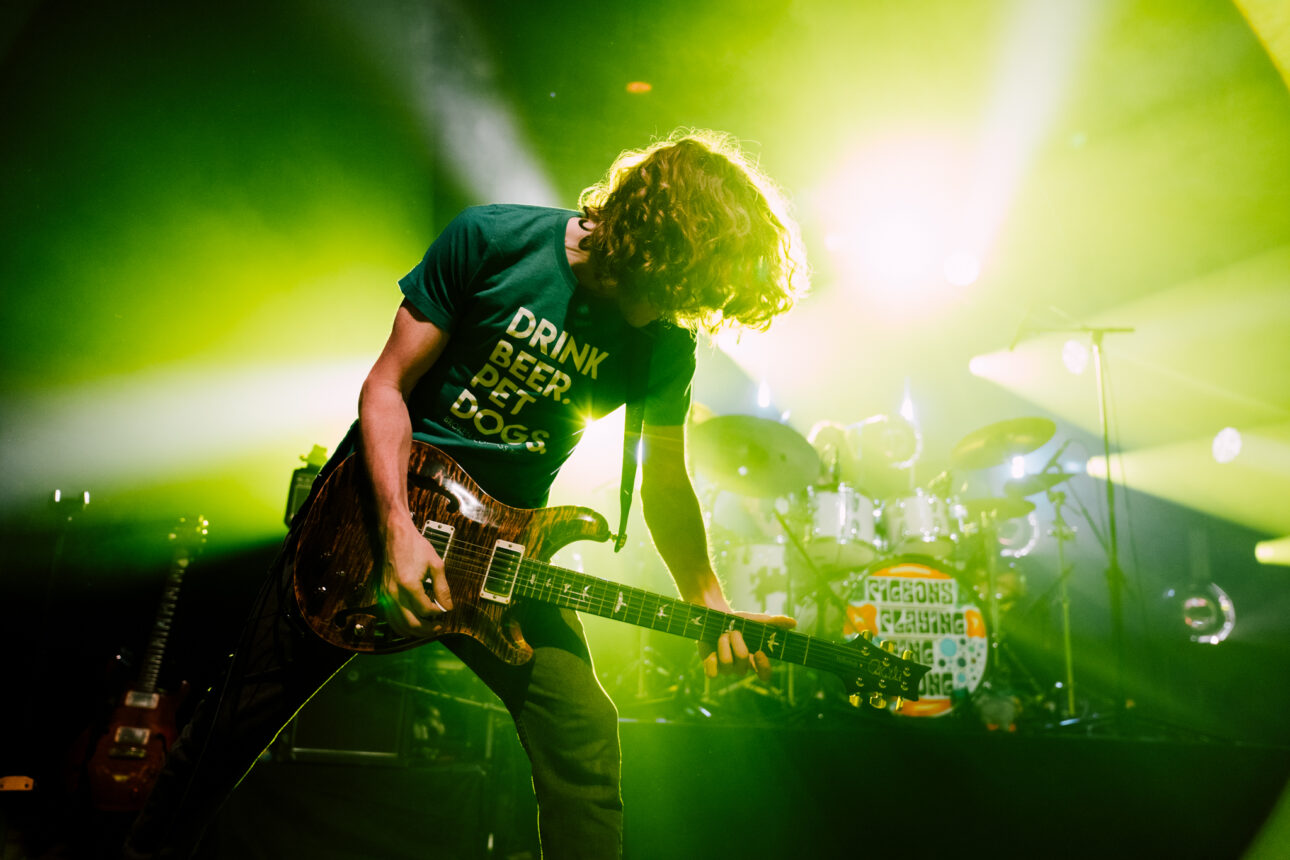
It’s their most textured work yet, though you’d never guess these intricate studio creations get stretched and reimagined nightly through their PRS guitars, like Ormont’s battle-tested 2004 Custom 24 (a thousand shows deep) and Schon’s modified Hollowbody II that’s been his companion for over a decade.
I caught up with both guitarists to discuss how they’re nurturing their creative fire, why their collaboration with PRS guitars is a natural marriage, and how they balance their dense touring schedule while keeping every performance completely unique. Plus, what their favorite songs are, and how SpaghettiOs may, or may not, have made the band’s name miraculously materialize from the soup realm.
Greg, you’ve described “Feed the Fire” as being about nurturing and spreading the passion that the band and fans share together. How do you hope this fire will catch with new audiences, and what do you want listeners to feel when they experience the record?
GO: We poured our hearts and souls into this album and I hope people feel inspired to do the same in their lives. We look at recording albums as a metaphor for how we approach life in general. We’ve all been given this amazing opportunity to live, create, and spread joy, so we’d be fools to squander it. I never want to look back at our albums, shows, or anything for that matter, and ask myself if I could’ve tried harder or given it more. I sleep well at night knowing that we gave everything we had recording Feed The Fire.
What’s your favorite song on “Feed the Fire” and why?
GO: I’m not one for “favorites” per se, but I must admit that I love playing the title track, Feed The Fire. There’s something about the triumphant peak that sends me through the roof every time. But I truly love playing all the new stuff. As a band, we’re always chasing novelty, which is a big reason why we improvise every night; we never know where the music will lead us.
What inspires you creatively?
GO: As a lyricist, there are all these big grand ideas that are constantly bouncing around in my head, but it’s often hearing a unique turn of phrase that actively gets my wheels turning, which is partly why I’m such an avid reader. Just the other day, I was watching an interview of one of our contemporaries talking about songwriting when something clicked and I wrote a new song on the spot. As for inspiration on guitar, nothing gets my blood flowing more than catching an incredible live show.
I read that the band plays as many as 200 shows per year, which is wild! How have you found PRS guitars to handle through your pretty rigorous touring schedule?
GO: My Custom 24 is a thousand shows deep and ready for 10,000 more. It’s a testament to the craftsmanship, precision and consistency that we’ve all come to expect from PRS.
What specific PRS features (pickups, switching system, neck profile) are essential for your playing style?
GO: I’m pretty easygoing when it comes to guitar specs. Most importantly, I’m looking for a Pattern Thin neck with a volume knob within pinky’s reach for volume sweeps and economy of motion.
Favorite guitar and why? Does it have a name?
GO: I absolutely love everything about my 2004 PRS Custom 24. As for a name, I’m a bit superstitious there. In the past, whenever I’ve named inanimate things, they would break immediately. So don’t expect a name for it any time soon.
In some of the interviews I’ve read, there’s a fascination with the band’s name and its origins. Can you share how the band’s name came to be?
GO: Believe it or not, I’ve been asked this question a lot and I’ve given a variety of phony answers. Today, I will finally tell the truth: I discovered our band name in a bowl of SpaghettiOs.
Jeremy, you’ve talked about how “Feed the Fire” reflects where you are personally and musically, and that you really leaned into exploring textures and pushing boundaries. Can you give us some specific examples of how you pushed those boundaries and what new fibers you’ve woven together through the process?
JS: We really embraced the idea of collaborating with other musicians on this album, and decided to feature more guest contributions than we have before. For example, our friend Wes Bailey from Moon Taxi added a bunch of production layers to the song Feed The Fire, and we decided to keep them all, and feature them in the mix more than we would have on previous albums. This album also marked our first time collaborating on a writing level with our guests.
What’s your favorite song on “Feed the Fire” and why?
JS: Hard to pick a favorite, as I really like them all. As a guitar player, I’ve been really enjoying playing Underworld live. The song has a deep funky pocket, a fun 2-part guitar harmony section, and it revolves around a dark E minor phrygian based progression that is really fun to play over. When we play that one live, we tend to stretch it out pretty far too. We also collaborated with one of my favorite musicians, John O’Hallaron (AKA Chalk Dinosaur), on this track, and he helped re-write my guitar parts over the verse, along with contributing some very tasteful synths throughout the song.
What inspires you creatively?
JS: Nature and music. Going hiking and immersing myself in nature definitely recenters me and helps me get inspired. However, nothing inspires me creatively more than seeing live music, and I’m constantly listening to music at home, too.
You’re known for these incendiary, face-melting jams that can stretch for 20+ minutes. How do you know when to push further into the psychedelic void versus when to bring it back home? Is it reading the crowd, reading the band, or purely intuitive?
JS: It’s a combination of all the above! If we’re in the zone, we might just keep pushing each other in a jam or solo until we feel we’ve reached our peak moment before bringing it back home. We’re always listening for musical cues from each other, and since we’ve been playing together for so long, it really has become very intuitive for us to improvise cohesively as a single entity. Sometimes you gotta read the room too, and if a crowd isn’t feeling a 15-minute psychedelic journey, we try to tailor the jams appropriately to match the vibe and energy in the room. We try to write our setlists to have an appropriate balance between songs and improvisation, keeping it interesting for us and the fans.
How does your PRS setup complement Greg’s in creating the band’s layered guitar sound?
JS: My PRS Hollowbody II has a woodier and more resonant sound compared to Greg’s solidbody PRS. We also run through pretty different pedalboards, and I run through a 1968 Fender Bassman amp with a closed-back 2×12 cab, versus Greg’s more tweed-voiced Victoria Golden Melody combo amp.
Have you made any modifications to your PRS guitars to suit the band’s needs?
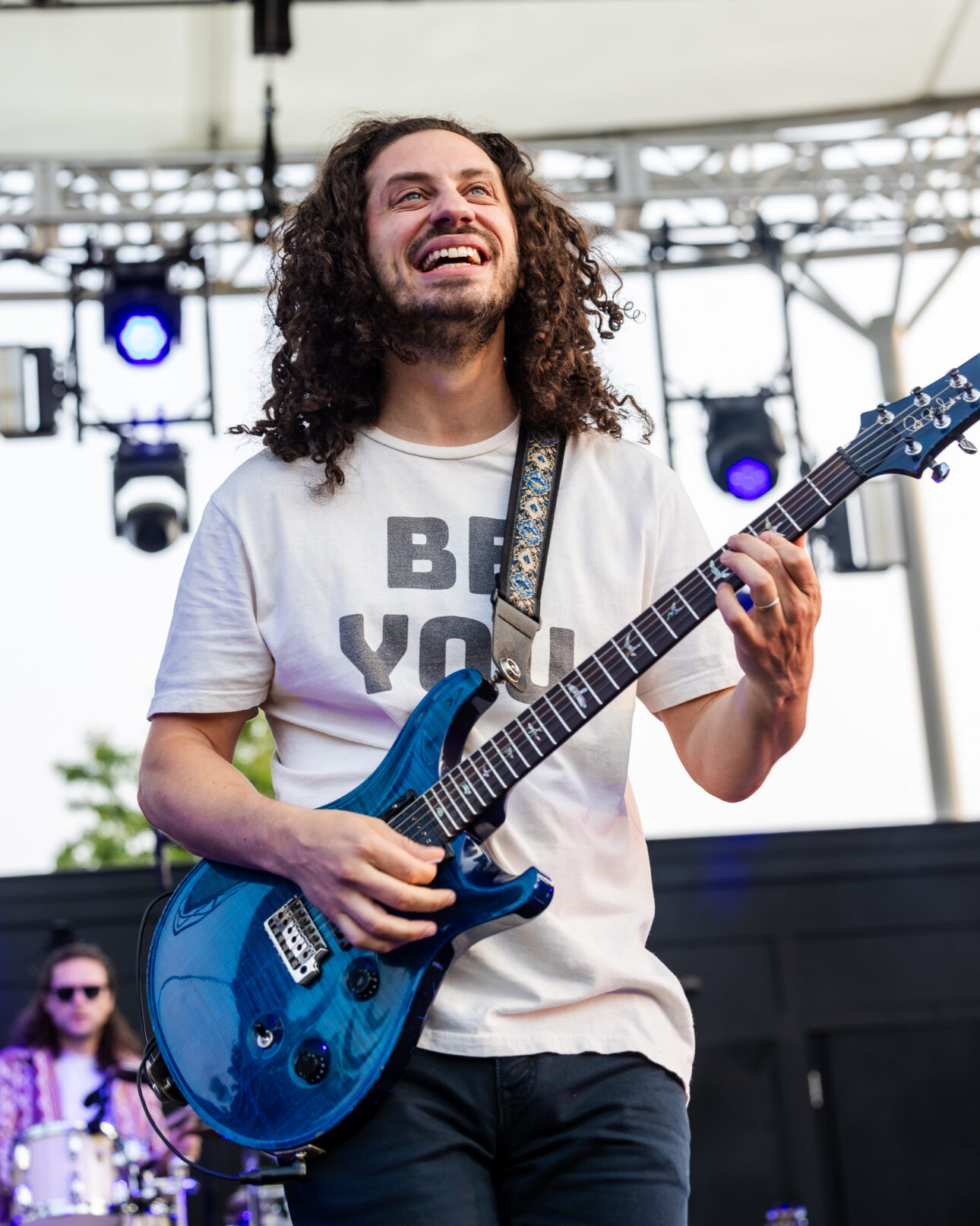
JS: I have! On my red burst 2006 PRS Hollowbody II, I’ve had a few modifications done. First I installed PRS phase 3 locking tuners. Then I had the piezo system removed since I occasionally would accidentally hit the piezo switch during a show, which would sometimes cause the signal to cut if the battery was dead. I’m generally not a fan of having anything that relies on batteries in my signal chain. However, the PRS piezo pickup sounded awesome, and I still have that on my 2022 HBII – just wasn’t something I ever used with the band. I also just recently swapped the original Archtop pickups out for the new PRS McCarty III pickups, which seem to cut a bit more in the mix, and added coil taps so I can get single coil tones too.
Favorite guitar and why? Does it have a name?
JS: Both of my PRS Hollowbody IIs are my favorite guitars. I’ve been playing the red burst one for 11+ years so that’s been my go-to, but I really love my newer 2022 yellow tiger model too, and I go back and forth between which one I play live.
Greg and Jeremy, what song would you consider to be your individual theme songs and why?
GO: We have a song called Horizon which starts with calm lyrics about settling into a concert, then propels down an epic guitar-driven odyssey, finally culminating with the uplifting refrain, “celebrate the people you love.” Every album and every show serves as another chance for us to “celebrate the people you love,” and I hope that always resonates from the stage and through the speakers.
JS: Agreed on Horizon, it definitely captures a strong essence of what our band is about both musically and lyrically. Gotta celebrate the people you love!
Can you both describe a moment on stage where your PRS guitar really came through for you and created a memorable experience?
GO: I was smiling ear-to-ear when I first played my Silver Sky live. As a funk guitarist, I’d been searching for a strat sound that still felt like home in my hands, and PRS came through in the clutch. Things got funkier, fast.
JS: I used to have to fix my intonation pretty regularly when I toured with my Epiphone Dot. Once I switched to the PRS Hollowbody II, I’ve hardly ever had to touch anything beyond a yearly tune-up.
OK, so if your PRS guitars could talk, what stories would it tell from the road?
GO: “You think I’m covered in sweat? You should see the strap!”
JS: “Remember that time Marcus King played me late night on Jam Cruise? I can’t believe you let someone play me after 3am!”
If Paul Reed Smith came to a Pigeons show, which song would you guys want to be playing when he walked in, and why?
GO: I’d have to point back to our song Horizon. I would love for Paul to experience the pure joy bouncing around the room at the song’s peak, and for him to appreciate his role in creating such magical moments of human connection.
JS: Ideally we’d pull Paul on stage for an epic jam on Poseidon! Consider this an official invite.

