

Eugene Hütz got his first taste of faraway New York in 1989. He was just 14 then and growing up in Ukraine, when an uncompromising rock band called Sonic Youth exploded his mind with waves of experimental sound, hot-rodded guitars, and avant-garde tunes. Two decades before starting his own band, Gogol Bordello, Hütz discovered his life’s mission.
“I go and see this band that’s supposedly synthesizing hardcore and Velvet Underground and no wave,” recalls Hütz. “And somehow it’s still catchy, like it’s Motown. That really appealed to me. My vector was defined: I have to go where this music came from.”
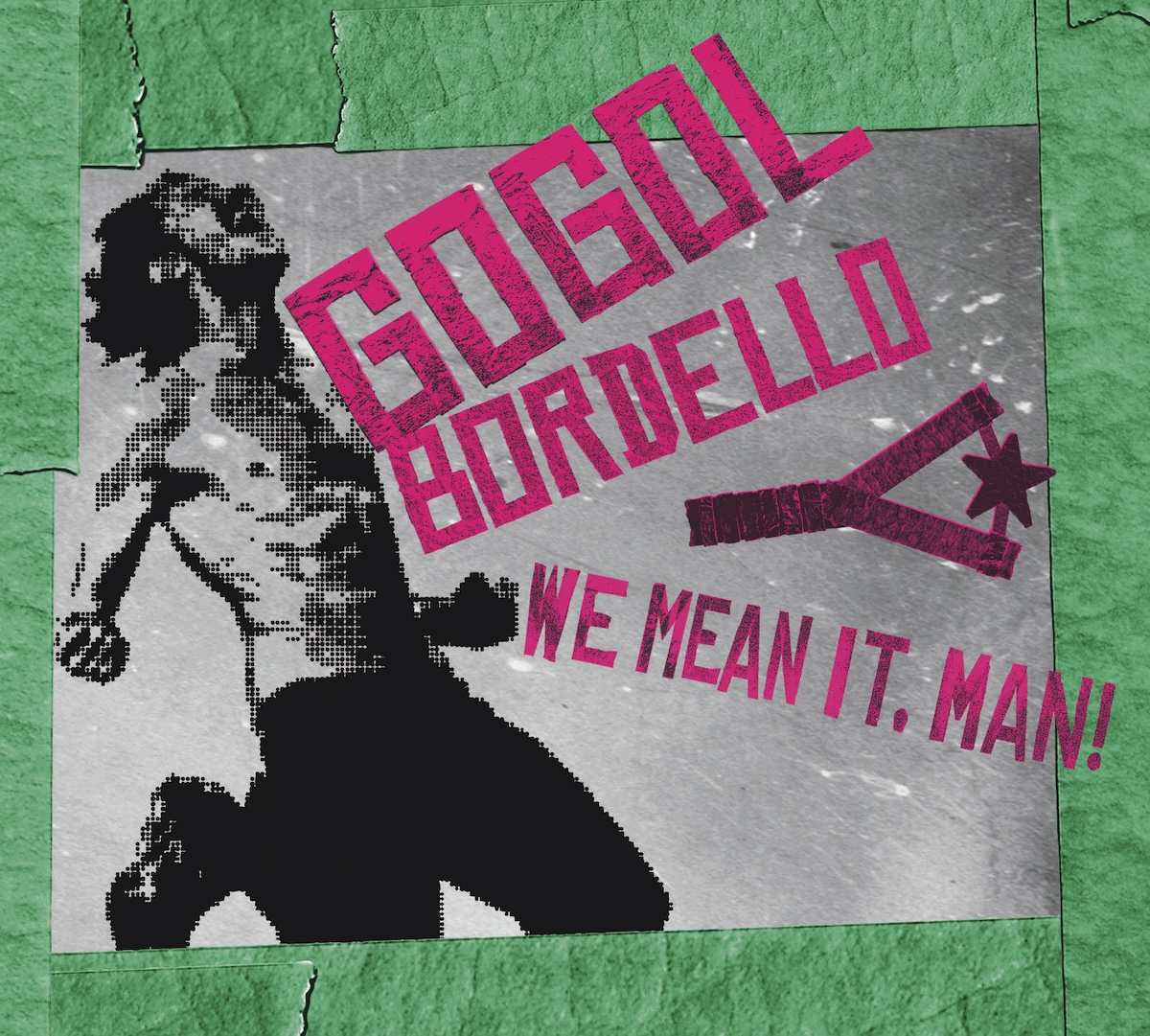
It would be a long time before Hütz made it to New York, but he would spend years immersed in punk, post-punk, hardcore, no wave, proto-punk, digital hardcore, and other subgenres outside the mainstream. It was the fuel that led him to create the wild gypsy post-punk of Gogol Bordello, and can be heard explicitly on their new album, We Mean It, Man!, set for release February 13. The album title was lifted from an old Sex Pistols lyric.
To get there, Hütz left Ukraine and spent time first in Poland, then Hungary and Austria, then Italy, before making it across the Atlantic and landing in Vermont. While living in that New England state, he soaked up as much East Coast hardcore and indie rock as he could. (He saw Fugazi five times in Burlington alone.) While there, he founded the ‘90s punk band the Fags. But it wasn’t until he arrived in New York’s East Village that all of his musical dreams and experiences came together in a strange but festive hybrid as Gogol Bordello.
“I wanted to recapture the distinctly postpunk groove that was there for all of us when we listened to Gang of Four and PiL and Killing Joke, bands that I will never consider archaic because if you listen to Viagra Boys now you can hear all of that there,” says the singer-guitarist. “You can hear the vitality of post-punk. It’s such a great stripped-down way of delivering impactful music. Riffs, humor, the art element, are really rich in there. Amyl and the Sniffers and this wave of new bands keep this genre really pumping and alive.”
On We Mean It, Man! are 12 forceful songs, beginning with an opening title track that is filled with punk rock attitude and an echo from the Sex Pistols’ iconic “God Save the Queen.” It was co-produced by Nick Launay (Nick Cave, Amyl and the Sniffers) and Adam “Atom” Greenspan (Cave, PJ Harvey).
“To record high-energy music, and have it live on digital tape, it’s a science,” he says. “I’ve been incredibly lucky to work with the greatest producers.”
Over the years, the band has also worked in the studio with the likes of Rick Rubin and Steve Albini. Hütz has produced some Gogol Bordello recordings himself, including 2017’s Seekers and Finders, but he remains a student of the power and mysteries of the recording studio.
“I’ve been sitting at the mixing desk for so many years, watching over the shoulder, collaborating or just observing,” Hütz says of the producers he’s worked with. “Every one of those people is a philosopher, an Isaac Newton in his own right. They’re alchemists of their own category. And this particular record was to capture that super-high energy with layers of subtle electronics and sometimes less subtle electronics.”
On the driving single “Hater Liquidator,” Hütz snarls to sounds muscular and playful: “War, pandemic / What else do you need / To see who’s made out of what … Somehow between / All your dry heaves / Time slips the magic up your sleeve.”
On the hopeful “Life Is Possible Again,” his mind is on the war in Ukraine, but also “many other cataclysms in the world.” And some of the troubles he sees remind him of past world-altering inflection points.
“We are persevering through very absurd times right now,” Hütz says. “Like the Leonard Cohen song [“The Future”]: ‘I’ve seen the nations rise and fall’—I’ve lived a lot of that as a kid: the biggest, grandest, most indestructible thing in the world, the Soviet Union, it’s always going to be here. And next day it’s gone. The Berlin Wall, this thing that you grow up with, boom, it’s out. September 11 happens, another era closes down. It’s era-shifting.
“But it feels like, right now, things are actually pretty close to spinning out of control,” he insists. “This can’t go on like this anymore. And we’re feeling like we are on a brink of extinction. There is this real, real, real, real, real, real longing for that moment where we can all say that life is possible again. Where people can start looking at each other worldwide as part of the same organism again.”
We Mean It, Man! closes with a remix by Launay of an earlier single of the song “Solidarity,” a collaboration with Bernard Sumner of New Order and Joy Division. Working with the first-wave punk and post-punk singer-guitarist was an impactful experience, taking him back to his discovery of that generation of punk-rock revolutionaries. He calls Joy Division’s meditative “Heart and Soul” an essential piece of music, which he compares to Ravel’s “Bolero.”
During the making of “Solidarity,” Sumner didn’t just drop in for a quick vocal, guitar, or keyboard part, Hütz says, but worked as a true collaborator on the song. “Making a track together with Bernard was mega-meaningful,” Hütz adds. “He contributed an amazing amount of work to it. He didn’t only sing on it, he did the arrangement, all the synthesizers. He mixed it. It was a huge deal for me.”
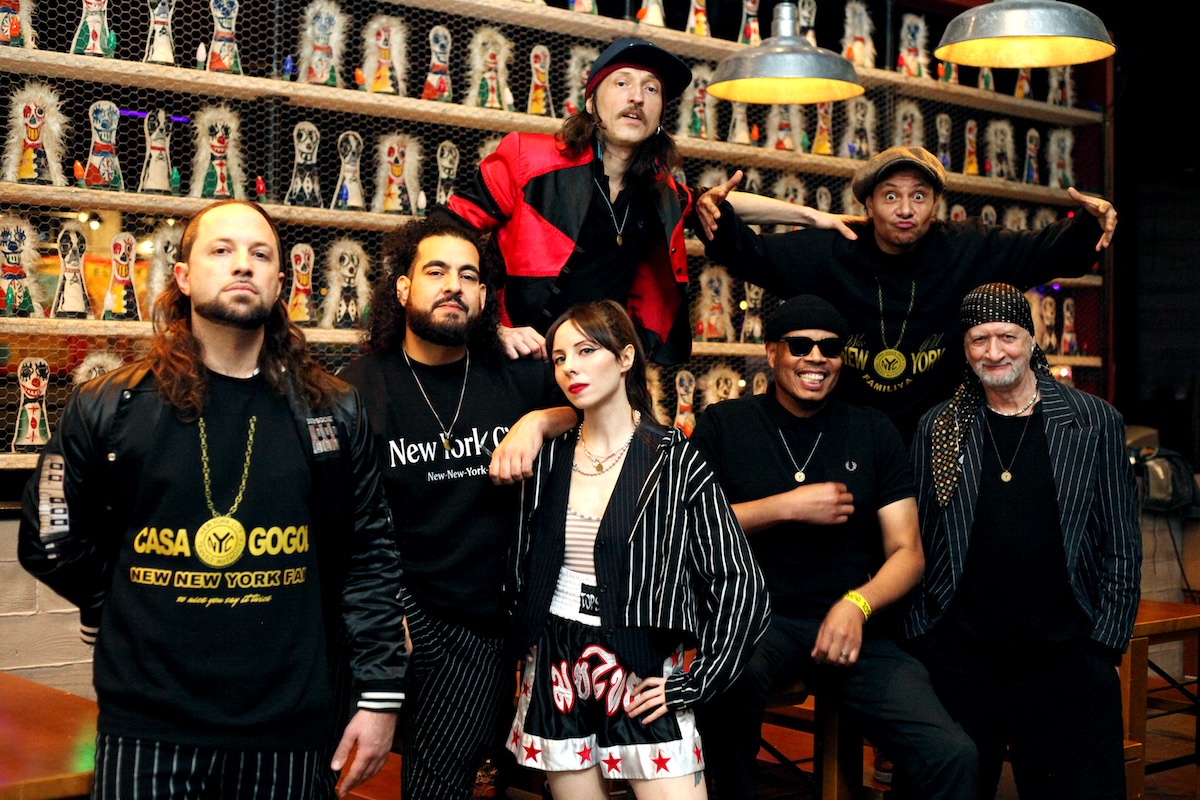
The punk song was originally recorded in the late-1970s by Angelic Upstarts. The new version with Sumner was the first single released by Hütz’s indie label, Casa Gogol, launched at the end of 2023. The record was also sold to raise funds for war-ravaged Ukraine. Soon after, the label released records from Puzzled Panther and singer-songwriter Grace Bergere. There was also the haunted “Raven,” a duet between Hütz and Karen O of the Yeah Yeah Yeahs.
“I always wanted to start a label. A lot of my friends who had successful labels were talking me out of it: ‘Oh, don’t do it, man! It’s gonna be more work than you think!’ But I should have started earlier,” says Hütz. “I went and saw a couple bands. I got into a bubble of new artists that I really thought have a great sense of earnestness and urgency. And they reminded me of me the way I was in ’97, ’98 in New York City.”
He’s working on a memoir of some of those early musical adventures, with the working title Lost Innocent World, named after a 2013 Gogol Bordello song. Even with that and his label, he still considers the band as his main outlet for his many creative interests.
“Gogol Bordello is that tunnel where I’m trying to cram it all in,” he says. “I always try to avoid this word ‘workaholic’ because I never feel like I’m working. I grow through my work.”

