

Florence Shaw doesn’t tell jokes. As the singer-lyricist for the British post-punk band Dry Cleaning, she speaks in fragments and riddles, in social commentary and startling understatement, mixing serious notions with observations on the human comedy all around her.
“We take humor pretty seriously,” says Shaw, whose exceedingly calm sung-spoken delivery is an essential character of the group, at times sounding detached, or maybe quietly judging you. “It’s quite a big ingredient of our band. But I think humor on its own is not always the most interesting. It’s good to have several things going on.”
During early songwriting sessions for the quartet’s new album, Secret Love, out January 9, the band gathered at The Loft, Wilco’s studio in Chicago. And like so many times before, Shaw listened and reacted to the noise in the room. Hearing the band’s playfully jagged riff from a song titled “My Soul / Half Pint,” she calmly recited into the mic: “I don’t like to clean / I find cleaning demeaning.”
“That’s my favorite line,” says guitarist Tom Dowse. “When Flo said that at The Loft, I remember thinking, ‘This album is gonna make us rich!’” As the rest of the band laughs out loud, Dowse adds of their songwriting process, “That’s what’s great about working with Flo, because it always surpasses what you imagined. She’s talking about feminism and about women’s role in domestic chores, but it’s pissed off as well.”
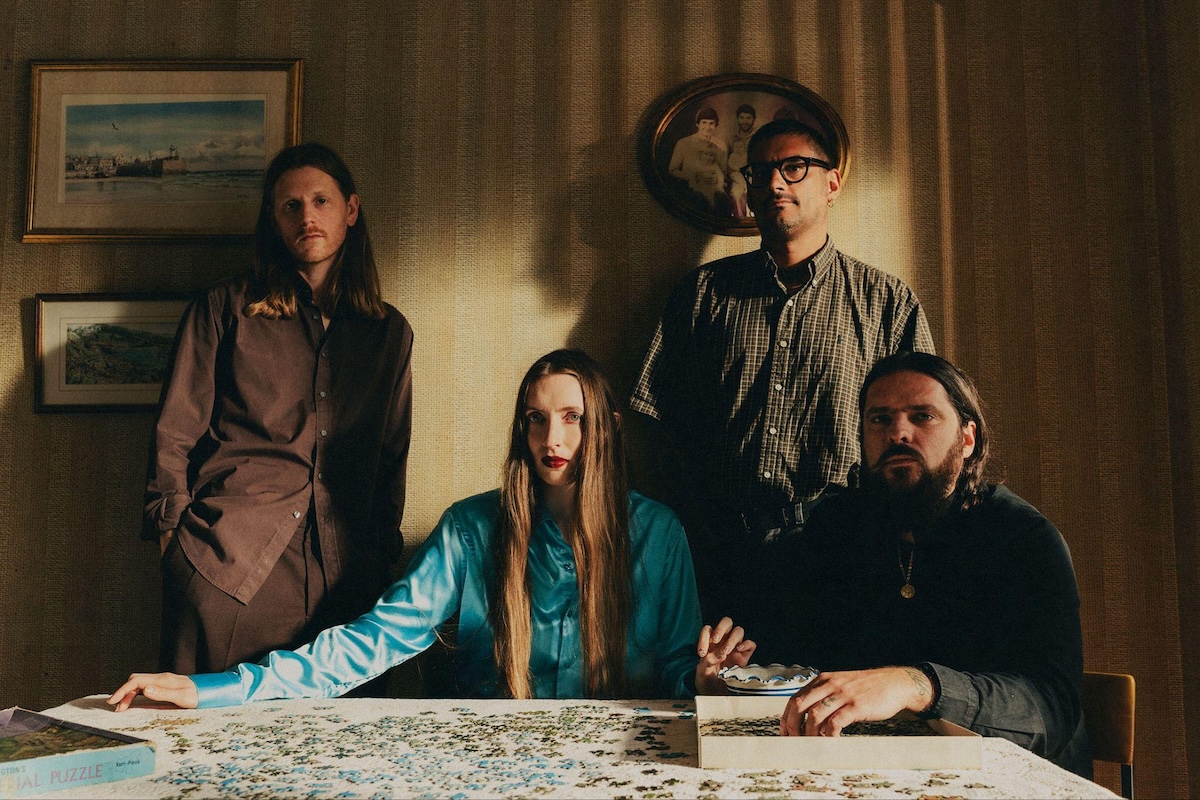
The four members of Dry Cleaning are sharing stories about the making of Secret Love in an afternoon video call, signing in from their homes in South London, all within walking distance from one another. The album’s 11 songs, produced by Cate Le Bon, show the group exploring new sounds and genres mixed within their existing art-punk framework, as Shaw experiments with a distinctive vocal style that is somehow both biting and strangely relaxed.
On the single “Cruise Ship Designer,” she casually inhabits the song’s title character, and recites, “Cruises are big business / I don’t personally like them, but I need to serve a useful purpose.” Then, as if speaking for creative subversives everywhere, she concludes, “I make sure there are hidden messages in my work.” The lines are funny and alarming at once, her vocals restrained but never listless against the nervous energy of the band.
“In a way, a lot of what I do is about being a bit of an oddball, feeling like a person that doesn’t fit really comfortably,” says Shaw, sitting in front of a full bookcase, cheerful, with long caramel-colored hair, glasses, and a black T-shirt. “I think that’s quite a lot of what I’m about. That comes through in the music in one way or another.”
The rest of the band nods or smiles in agreement. Drummer Nick Buxton, blonde in a gray hoodie, shares a couch with his dog, now 15 years old and graying, calmly wrapped in a blanket. Bassist Lewis Maynard, bearded with dark hair long past his shoulders, eagerly leans toward the screen.
The new album was recorded in the Loire Valley of France, and comes three years after 2022’s acclaimed Stumpwork. Without abandoning their spiky aesthetic, Dry Cleaning stretch out in meaningful ways. Layered within gently cascading instrumentation on “Let Me Grow and You’ll See the Fruit,” Shaw sings-speaks evocative stream-of-consciousness lyrics on what she calls “hyper-focus and loneliness.” There are also moments of melodic singing on “The Cute Things,” accompanied by music that is the album’s most joyous and excited, and again on the album-closing “Joy.”
“I always like it when you sing because it’s selective,” Buxton says to Shaw. “When there are sung parts, they always have quite a big impact.”
If her usual vocals have often suggested the soothing tone of post-millennial malaise, the band is a dependably dynamic balance of sounds angular or dreamy. Its foundation are the prominent, active basslines of Maynard, tapping into a legacy of that first-wave of floor-shaking, iconic post-punk bassists: Jah Wobble, Peter Hook, David J, etc.
“That kind of freed up the guitar to do some different weird stuff, and that really suited the way I wanted to play,” says Dowse, bearded and reclining in a burgundy Adidas jacket.
While usually labeled post-punk, their most direct influences weren’t the historic U.K. bands of that original movement (Wire, Magazine, Joy Division, etc.), even if they admittedly obsessed over them as adolescents. Instead, Dry Cleaning came to their sound in reaction to their love for music that came out of Athens, Georgia, first with Pylon and then REM.
“We were definitely listening to things with a slightly more pastoral vibe to it,” says Dowse. “We kind of liked the Americana-ness of that as well, because it’s a little bit softer and not quite so industrial-sounding as the British post-punk, which is quite disenchanted and quite an angry sort of thing.”
That said, the music of Dry Cleaning can be as noisy and edgy as Wire, but coming from what Dowse describes as “a sort of chill vibe post-punk,” meaning an impulse toward the melodic and more danceable. Dowse notes that “post-punk” is now four or five generations removed from that original movement.
Shaw is still not sure how all of this happened. Back in 2018, she was working as a visiting art lecturer with no plans for rock stardom when Dowse invited her to come to a rehearsal of his band. And maybe she could try singing? The unnamed trio were a gathering of friends who jammed mainly for their own amusement and as an excuse to get together. No one had any expectations.
They rehearsed in the tiny basement of Maynard’s parents on Boundary Road, sharing the space with a washing machine and an urn holding the ashes of the bassist’s late grandmother. (Their 2019 EP, Boundary Road Snacks and Drinks, was named for it.) And as it happened, for the previous year or two, Shaw had been collecting words and phrases, either created by her or simply overheard out in the world, that she typed into the Notes app on her phone. She didn’t think she was writing anything, not even poetry, and certainly not song lyrics.
“Before I went to the rehearsal, I was really reticent,” she recalls. “I was like: never been in a band before, never tried to be in a band before. What the hell am I gonna do? I was kind of nervous.”
Sensing her worry, Buxton sent her examples of compelling vocalists who don’t sing in a traditional powerhouse style—a short playlist that included Grace Jones. It helped, so when she finally got the nerve to step up to the microphone, what came out was not far from the sound she soon developed: measured and composed, at times mildly judgmental, crisply skating across their bristling melodies.
“I wanted simplicity, I suppose. To me at that moment, [the answer] was to kind of speak it,” Shaw remembers.
Buxton recalls her first moments at the mic: “We were playing for maybe an hour or so, and then you were like, ‘Okay, I’m going to sing now.’ And I remember just laughing.”
They all recognized their accidental breakthrough. “It was immediate,” adds Dowse. “It wasn’t like a lightning bolt that said, ‘We’re gonna be rich!’ It was more like a lightning bolt of, ‘Wow, this really fits perfectly.’
“I could hear what she was saying perfectly, and the words were funny and interesting and quite like punk to me,” he goes on. “The kind of stuff she was saying was punk in the sense that they’re quite a provocative thing to say. I totally bought in straight away.”
Their first indie EP release, Sweet Princess, only happened because someone returned a favor to Buxton with an offer of some free studio time. That first recording was heard by another band, who asked Dry Cleaning to open for them, and suddenly they were a real band standing onstage. “We didn’t even plan on playing a show,” says Maynard. “It was kind of just a social thing at first.”
By the time of the Boundary Road EP, things had accelerated to the point of making their first tour of America in March 2020. As it turned out, that’s also when the pandemic came crashing down, just as they arrived in Los Angeles. They played a raucous show at the nightclub-restaurant El Cid, but all touring was cancelled by the time of their next gig at L.A.’s Echoplex a few days later.
“The word ‘COVID’ was invented while we were in America, it seemed like,” says Dowse. “As we were making our way west, it was basically locking down. So by the time we got to L.A. it was done, and we flew home. I was thinking, fucking typical. Like, you make it and then the world collapses.”
Maynard compares the moment to “a disaster movie,” and Buxton calls it “the most Hollywood thing ever.” The drummer then adds of that last night at El Cid, “So many people have come out the woodwork now that are like, ‘Oh yeah, I was at that show,’ and you’re like, what the fuck? We were like the last band to play in America. And afterwards it was just scorched earth.”
As the music industry ground to a halt, Dry Cleaning were off the road for a full year. In the beginning, they were isolated even from one another, passing around a Tascam recorder for each to add their parts to a new song, film themselves on their phones, and then post the results on YouTube. They were soon back to rehearsing in a friend’s nightclub that was closed for the pandemic.
“It was underneath the railway arch, not far from London Bridge station, so every time the train would go over, you couldn’t hear what you were doing,” says Dowse.
As the coronavirus crisis dragged on, the band used the time to record their first full-length album, New Long Leg, their debut for the mighty 4AD label. Produced in Wales by John Parish, well-known for his work with PJ Harvey, the record was released in 2021 to great acclaim. (The Guardian called it “as singular as it is dazzling.”) A year later came Stumpwork, also recorded with Parish, showing further evolution: The jagged riffs on “Drivers Story” could fit the most stressed tune by Television or Sonic Youth, while the shimmery funk of “Hot Penny Day” accompanied Shaw’s vocal of restraint and rage. (Lyric: “Our relationship, well, it’s not what you think it is …”)
The pandemic led to an especially creative period, but Secret Love didn’t come for over three years, which may better reflect their natural pace.
“It’s not like an Elton John kind of thing where you sit at a piano and just turn out songs,” Dowse insists. “We are quite good at not putting any pressure on ourselves when we write. We just jam a lot. Sometimes you write a song almost as quickly as it takes to play it.” At other times, like on the new album’s jangly and effervescent “Blood,” music and lyrics took “donkey’s years” to coalesce, he says.
While all songwriting credits are shared by the band, lyrics are clearly Shaw’s special gift, pieced together as the rest of the band jams out musical ideas.
“Certainly on this record, I wrote a lot of indirect responses to the music being written live around me,” Shaw says. “I’ll be picking up on the mood or the tempo or the character of what the guys are playing, and writing in response to that.
“I take a long time and care a lot about the small details in everything. I’m quite intentional with everything I do.”

