

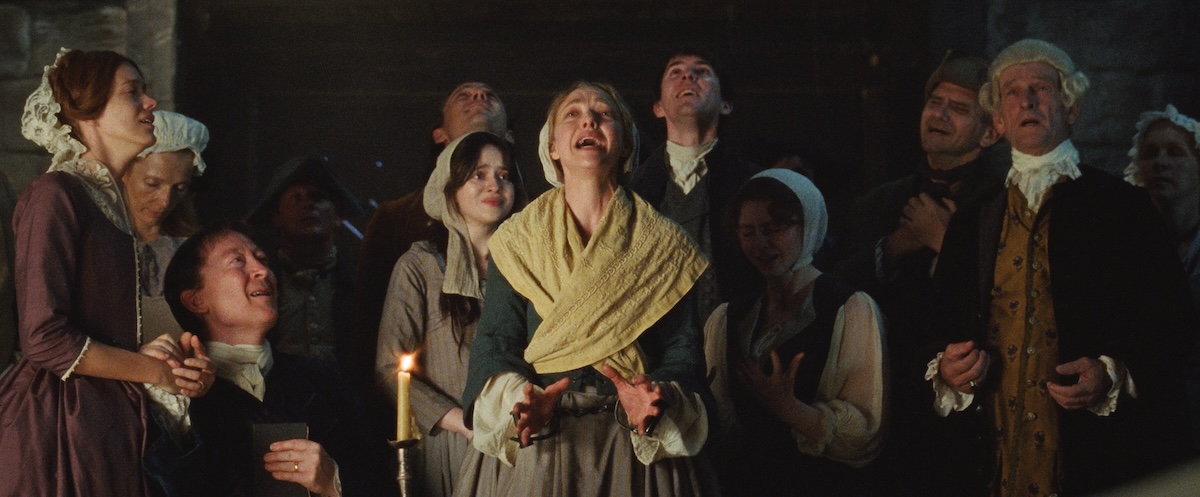
For his work as film composer for The Testament of Ann Lee, Daniel Blumberg went back in time. The film is a vibrant musical drama starring Amanda Seyfried as the 18th-century ecstatic religious leader who founded the Shakers, and the music was built from the organic sounds of human voices and the percussion of clapping hands and feet stomping wooden floors. The result is raw, deeply rhythmic, and strangely intense.
The film is his latest collaboration with Norwegian director Mona Fastvold, who wrote the script with husband Brady Corbet, their first project since 2024’s The Brutalist, which Corbet directed. In March, Blumberg won an Academy Award for best original score for The Brutalist.
Inspired by the original Shaker hymns, Blumberg created 110 minutes of music for the film, and the official soundtrack will be released January 16 as a double album that mixes score with songs sung by the cast. Among them is “I Love Mother,” inspired by the ancient “Pretty Mother’s Home,” one of 12 Shaker hymns used in the film. There is also a modern end-credits song “Clothed by the Sun,” a duet between Blumberg and Seyfried.
Throughout, he called on a group of leading avant-garde instrumentalists and improvising singers.
Blumberg also has an active career as a recording artist, releasing a series of albums on the Mute label. He’s just completed a film score for Gianfranco Rosi’s Sotto Le Nuvole, a documentary about the lost city of Pompeii, with music recorded largely underwater, and is on to his next project with Fastvold and Corbet.
In Los Angeles to attend the film’s premiere, I spoke with Blumberg about his life making movies so far. The Testament of Ann Lee opens across the country December 25.
“I love cinema,” he says in a video call. “I love going to the cinema, and I love that there’s a black border around this screen, and everything else just doesn’t exist. I got into cinema when I was 17. It became life-changing for me.”
You’re using the human body as an instrument in this soundtrack, with hand slaps and stomps in a way that’s not just percussion for a larger thing, but the actual center of a piece.
Yeah, this was a quite simple palette of body sounds, vocals, bells, and strings. With films, I like to create a palette that’s really designed for that world that we’re making from scratch. I did that with The Brutalist with piano and brass instruments. My last record, Gut, was all bass, bass harmonica, electric bass. So I do tend to get the palette together for the project that makes sense and tend to have quite complicated sounds balancing around—melodic motifs, choruses or something.
I understand you didn’t know anything about the Shakers before you got involved in this project. When you started to dig into what they were about, what did you discover?
I started from scratch because I hadn’t heard about the movement until I read the script. The first things that came to mind when I read the script were these improvising singers that I love, Phil Minton, Maggie Nicols, and Shelley Hirsch. I see Phil and Maggie perform a lot in London and they’re very influential improvisers. I was quite curious about that early formation of the Shakers, where it was documented that they were using wordless hymns and sounds, and body sounds, and I thought it would be interesting to have these extremities from that origin of stranger sounds and more free-sounding group of prayer—and then until the end, in the dance and the structure of the hymns, being more organized as they organized as a movement.
The hymns that you heard, what did you learn from that? Was there a certain aesthetic or personality that came through?
When I work with improvisers, specifically for my song records, I normally try to bring everyone the most-simple version of what I’ve written to give space for improvisation. It means that when I play live, every gig is different, because there’s this core that’s quite strong that we can move around. The documentation of Shaker hymns, it’s all very simple—it’s just one line of melody. When I started adding chords underneath, it’s quite malleable, while retaining the melody. So a song like “Hunger and Thirst” in the film, I added a middle-eight, and it still sounded like this Shaker hymn, but it also had this quality that was relevant to a moment in the screenplay.
When you take on a project like this, or The Brutalist, which also takes place at a certain time and place, do you become a musicologist and dig into the history of things that are relevant to that time and place?
I had to research as much as possible. I’ve never done, like, a PhD. [laughs] It was alongside Mona, and I spoke to the people at the Hancock Village [Massachusetts], where you’re immersing yourself in their material, and also their world. So being in the village, you’re in their furniture, in the rooms that they’ve built, and where Ann Lee was.
In pre-production, I was in meetings with the heads of departments, and you’d hear the production designer or the cinematographer talking about the visuals, and that might give you a clue. It’s all these little clues that you get that harness your instincts, so that when you’re in the studio with the musicians, or when I’m writing, I have all these clues from the conversations that I’ve had with Mona, or from hearing her talk to an actor about the intention for the scene.
Then I’m able to work as a songwriter, or as a composer, where I’ve got these things in my body. I’m emotionally inside the project, rather than academically inside it—“Oh, this is going to be this time signature and that”—because I never trained as a musician. I rely a lot on feeling.
I’m familiar with your early indie rock band, Yuck. Does that early period still have any connection to what you’re doing now?
That’s probably a bad example, just because it’s a long time ago and quite unrelated to my work, other than being quite into melody, and it’s probably [more] the solo records that I’ve been making. The records on Mute, like Minus [2018] and On&On [2020], were quite important touchstones for this project, because Mona encouraged me to work in the way that I do with songs. Anything before that was more like finding my way, who I am as an artist. I did a record with Low 11 years ago that hasn’t been released. I thought of them a lot during this process, and Mimi [Parker]—who died a few years ago—staying with them and seeing how the song was such an important part of their life, spiritually as well. We’re going to mix it one day and put it out.
I was listening to your most recent album, Gut, which is a very emotional record without being explosive, but it’s more inward.
There’s a really obvious link to my song work. Writing themes is quite similar to me to writing a chorus. It’s this thing that you want to hear again. Sometimes you’ll hear a chorus three times in a song. When I did On&On, there’s a song that repeats itself five times on the record. When I play live shows, I never have a set list, and sometimes I’ll just play the same song one after another. I’ll finish the song and then play it again. That just happened naturally, but it also comes from when you listen to music sometimes, you hear a song that you love, and then you just want to put it on straight away.
Was the opportunity to work on a musical dream come true, or a daunting challenge?
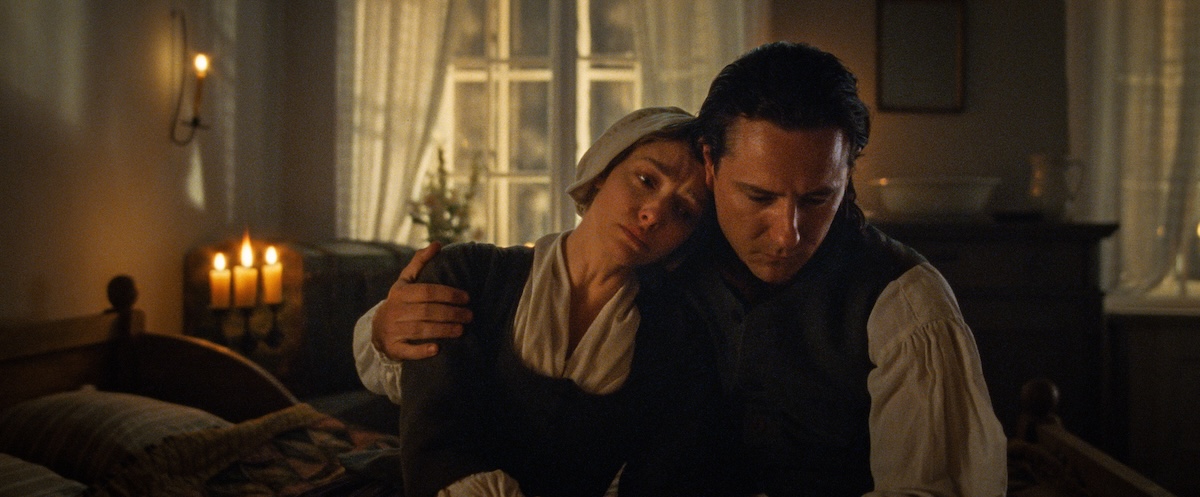
My dream is to work. That’s what I do with my day. I work on my music or my drawings. And I only dream about working, engaging with what I’m doing. With Mona, it’s this thing where I know that it’s going to be an interesting process, working with someone that I really respect. We have to talk to each other every day for a year and a half. She’s written this film and I’m subscribing to helping her realize that. Why would I want to do that instead of making my own record? It’s because together we’ll do something interesting
You have an ongoing collaboration with Mona Fastvold and Brady Corbet. What makes that work so well?
Well, I have different working relationships with both of them. They’re very different people. For example, Brady and I work very late into the early hours of the morning, and Mona definitely goes to bed earlier. I have a more physical relationship with Brady. Before we started doing film work together, we were always talking about our work anyway. I stayed on their sofa for years, so it’s quite a natural relationship. Now we do pretty much everything together.
What can you tell me about the song “Clothed by the Sun,” which is very different from the rest of the music in the film?
It arrives in the end credits, and it was something that I didn’t think was necessary initially. Mona and Amanda kept saying, “Write something, Daniel,” because [otherwise] it was going to be another Shaker hymn. I went into the cinema where we were mixing, and started writing, and the song just came out. I loved the song immediately. Sometimes when you write songs, you just sort of get a good feeling.
I know from making songs for 20 years that there’s a feeling you get when it just spills out. For me, the melody always comes quickly, and the lyrics sometimes take a while. This one, I think because I was so immersed in the project, they just all spilled out. When we watched the film with it in, it felt so correct to have this looser, slightly more contemporary song.
Amanda Seyfried’s pretty musical, isn’t she?
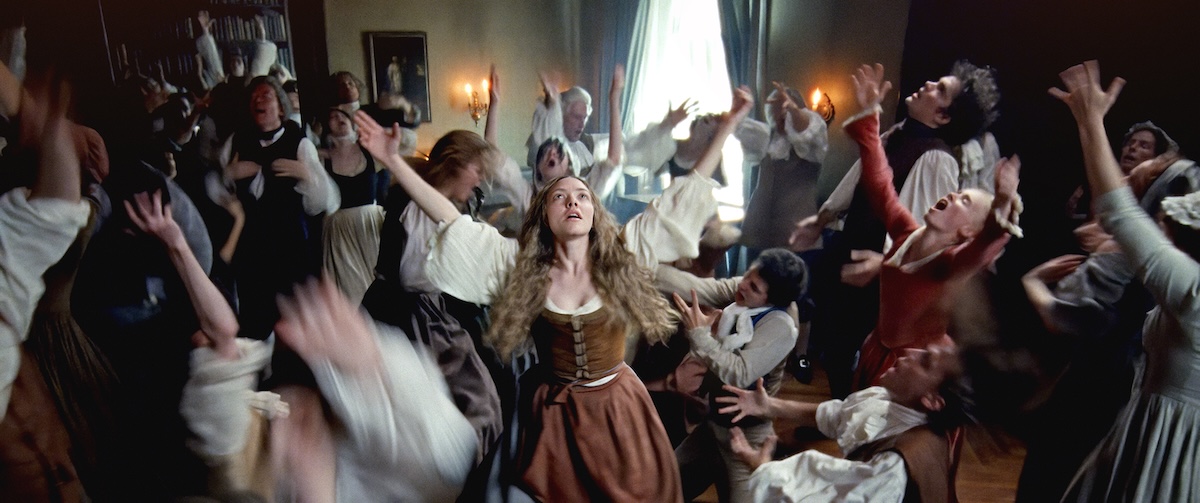
We come from very different backgrounds musically, but we connected as soon as we started working together. I knew immediately that we’d be able to work together well. She had a lot of trust in me. She knows how to read music, and she knows about time signatures, and I don’t. That was funny, because we definitely come from a different place, but she really extended her vocals for it. And she uses her body in a really interesting way with the sounds she’s making. And Amanda just went for it with all these strange techniques and pushing her vocal. Her range in the film’s really, really special.
What were you in the middle of when you had to go pick up your Academy Award in L.A.?
The Testament of Ann Lee. Literally, I took the plane the morning after [winning] and I got back to London. When I got the Oscar, they got me a business class ticket, so I got to sleep. It was really exciting, actually. I woke up in London, I called my engineer and said, “We can work today,” because I’d slept. And we recorded straight away, because Mona needed to finish the first lock of the picture by the end of March.
So if you hadn’t won the Oscar, would you have been flying back coach?
I’m not sure. But I put [the Oscar] in my kitchen.

