

Since Record Store Day’s debut in April 2008, its annual celebration of vinyl and the culture of independently owned record stores has only grown wilder: from its start in the U.S. to becoming an international event; from being held one day in April to the inclusion of a second event on Black Friday; from hosting 25 artists at its start to 350+ artists in 2026— all of which signal a juggernaut of sales and influence that reawakened the long-sleeping vinyl market.
Along with Michael Kurtz and his co-founders leading the charge and spreading the word of mouth, RSD has shared its commitment to vinyl with ambassadors such as Metallica, Iggy Pop, Brandi Carlile, Taylor Swift and, for 2026, Bruno Mars.
When the hotly-anticipated (at least, for vinyl nerds and crate diggers) list dropped on Wednesday for 2026’s April 18 date, SPIN’s A.D. Amorosi spoke to Kurtz about the business of being RSD.
Everyone knows why Record Store Day happened in the first place, in tribute to vinyl and indie record stores. But how did you and your co-founders make it happen, successfully?
I was living then in the Silver Lake neighborhood of Los Angeles, and moved there to get closer to the music industry. I had befriended Gail Zappa, Frank’s wife, John Densmore from the Doors, and several management types and record company executives. One day I walked into Warner Brothers’ offices and pitched the idea of a day dedicated to vinyl. Grover (aka WB executive Tom Biery) loved it, wanted to do it, and brought in Metallica to get involved. They loved vinyl. That was part of my RSD pitch: Can we release albums on vinyl again, bring vinyl BACK, and celebrate what it is to those who experienced vinyl before it went away? From there, I evangelized the idea to little record stores in the states. I’d call them; some were nice, some told me to get lost. I kept it together and kept networking with artists that was the key to making this happen. They wanted to do this with us. That first day, Metallica celebrated with us at Rasputin Music (Mountain View, California). Early on, there were a handful of artists who wanted to celebrate us, like Iggy Pop, Dave Grohl, and Ozzy Osbourne. They got it, loved it, helped get the records made, and from there, it snowballed.
Beyond word of mouth and artists celebrating vinyl—artists celebrating artists, really—was there a marketing plan, a secret sauce for success, that you started with, one that is still in place today?
Someone is going to call me a flake, but, at that time, I was reading a book about using the mind while meditating. After such mediation, I would call people, still high on the idea of doing something exceptional. I kept doing that, kept meeting more people, and building upon those relationships. That’s the secret to RSD: community. It’s a party. It’s hippie-ish if you think about it—it’s like an open-source event. I didn’t want to own it. Everyone told me to create a business model for RSD, make it where I’d make a dollar off every album sold. However, if I did that, it would confirm artists’ worst fears—that I was just doing all this for the money. So, I kept money out of it. And it wasn’t as if I was this genius who made it all happen because so many others kept bringing in good, even better ideas. I just listened, and channeled.
That’s a good point: How do you make money doing RSD? You’re a nonprofit, right?
We’re registered as a non-profit in our home operating state, but that doesn’t qualify in federal terms. In the most positive way, I hustle. We get sponsors for the website and the press team such as Monster, Tito’s Vodka, Marshall, Dogfish Brewery, and many others, all long-term supporters of ours. That’s where we get our money for payroll. There’s no money being made from the RSD releases. Many of our own releases (RSD-related labels such as RSD Essentials and the RSD New Artists Series in partnership with Atlantic) are done as fundraisers for good organizations and charity partners such as War Child UK. I make sure that the people who generously support us get what they need—like ListLaunch and the listening parties we’re having for them. We have an RSD Summer Camp conference, dedicated to being an independent record store, like the one we have coming up in July in New Orleans.
This is all part of creating an annual event—two annual events, now—in a competitive industry such as the music biz. Two days of selling records, 363 days of other stuff.
Yeah, RSD is so far beyond just those two days. Along with listening parties, we brought back midnight sales which used to be a big deal to the record store economy of the 1980s and ’90s. We started last year with the parties and the late-night sales, and now we do them like two, three times a week, every week. Once again, this enables indie record stores to succeed in a world driven by the internet.
Something tactile. Something you can touch, somewhere beyond your home where you have to go to experience this.
Yes. Look, we have to compete with the internet, streamers, artist pre-sales. Even in a physical form, we have to compete with chain stores like Walmart and Target—stores that jumped on the vinyl bandwagon just to drive traffic to their brick-and-mortar spaces like they did in the ’80s with CDs. Launching RSD Essentials for record stores is part of that. This week, we just rereleased the Danzig catalog. The RSD Summer Camp conference is coming up in July where 300 record store owners and music geeks pile into a New Orleans hotel for three days, excitedly talking about music. Plus, I manage the international side of RSD—we’re going into Korea. We’ve got a Japanese manufacturing plant for many pressings. It’s an adventure, it’s full-time, and all part of doing business, now that independent record stores account for, like 40% of all physical vinyl album sales—with RSD being the biggest part of that. We did that. We relaunched vinyl and aided greatly in that resurgence. When an artist, now, is preparing a campaign with vinyl, they look at our market shares compared with that of Walmart and Target; we’re bigger than they are. So, now the labels include independent record stores in their marketing plan. That makes RSD relevant. On the business side, we’re making things happen for our indie record stores. On the artistic side, we’re making such beautiful things in such small, limited runs. People finding an album where there’s only 8,000 copies made, or less—that’s something special.
Do you want to say something in a business sense about the expansion of the labels’ interaction with you since the start of RSD, the majors versus the indie labels? Even those retro-focused labels who came out of the culture of RSD.
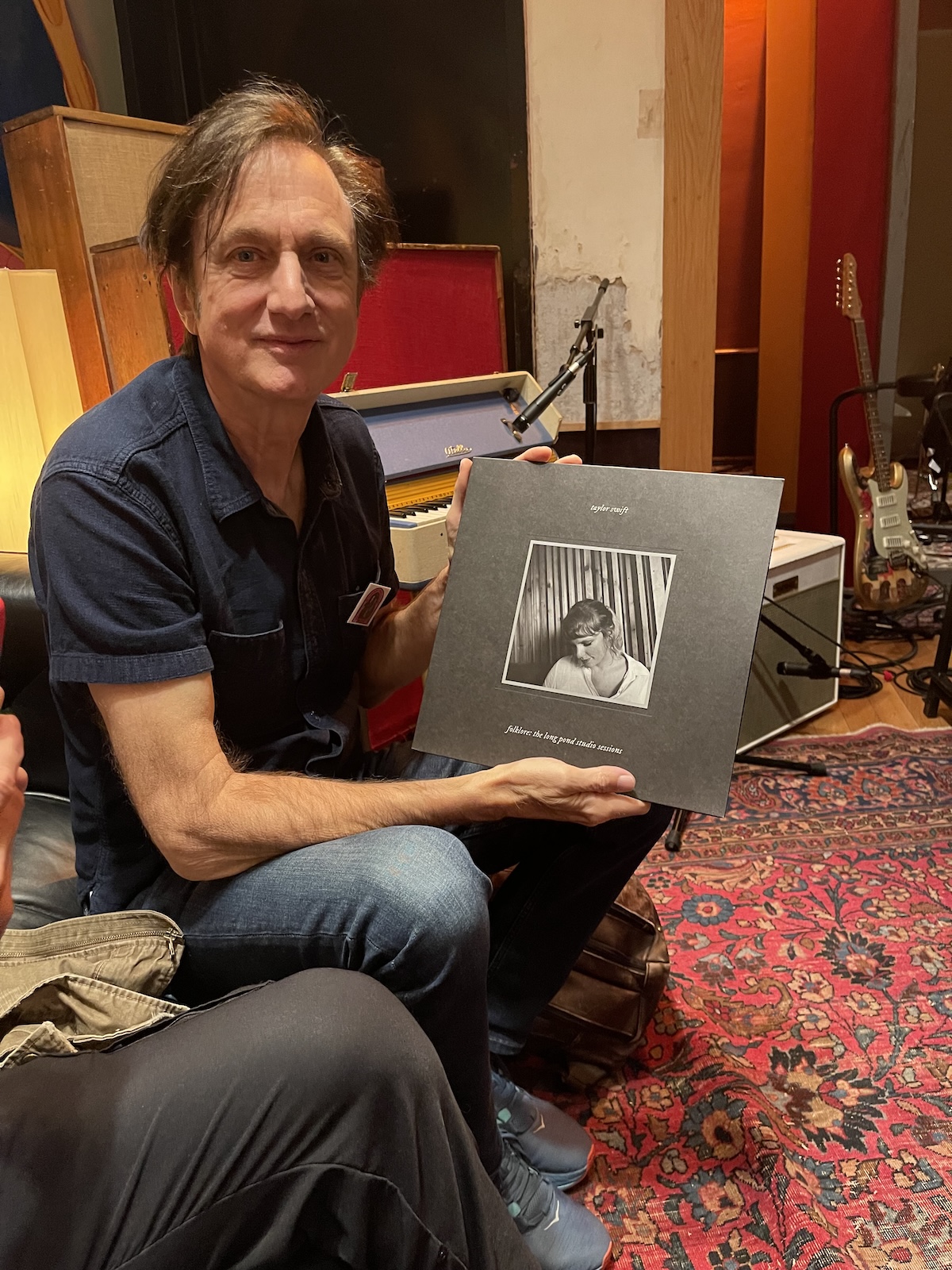
In the beginning, independent labels were not that involved because they didn’t have the confidence to press up vinyl where they had no idea if people would buy it or not. At $12s a copy, there’s nothing more depressing than seeing a stack of records sitting in a warehouse. It took a minute to get them involved. Now, independent labels make up 75% of RSD sales, so there’s that flip. On the major label side, the big game changer was having Taylor Swift get involved—she became our ambassador, our first Global Ambassador—in 2022 and gifted us with stuff like the unreleased orchestral version of “The Lakes” on a 7-inch, then gave us Folklore: The Long Pond Sessions, in 2023, for our largest-ever pressing, 115,000 copies. And they all sold out. That told the major labels how great we were at marketing.
Which brings me back to the artists who involve themselves with RSD: the ambassadors. Certainly Metallica, Grohl, Iggy, and Brandi did it. Involving brand names such as Swift and now Bruno Mars changes everything. I can see Taylor doing it, as she’s long connected herself to vinyl, but what about Mars? Is he a vinyl dude? How did you get him?
We had a meeting at the Chelsea Hotel a year and a half ago with Atlantic where they came to discuss Record Store Day releases, and brought up Bruno Mars. He hadn’t really done an album in 10 years, so we asked, does Bruno get it? Is he into record stores? The answer was a resounding yes, and if you see the video, you can feel how committed Bruno is to vinyl. He nails what it means to be connected to vinyl.
So, we did an EP with him for Black Friday 2025, and now, we’re doing an RSD-only The Collaborations with him which features his recent gig duets with Lady Gaga and Rosé. But, there’s a surprise—he has a previously unreleased track, his only-ever shot at making gospel music, and the only way you can get it is on this RSD Collaborations album.
You dropped 2026’s RSD list right before this interview, so I only know of a Pink Floyd live rarity from 1975, and a David Bowie Excerpts from Outside LP. Anything that made you go “wow” when you were presented with it for the April RSD?
We’re working with Ziggy Marley management on his new album, for RSD, where Ziggy is writing personal notes to go inside each copy of the record. The Bowie record sounds fun. KATSEYE are this amazing creative entity and cultural phenomenon, especially for kids 10 to 14 years old. When Interscope said we’d get something from then, that just seemed awesome. The same thing with this Wicked live event album with Ariana Grande and Cynthia Erivo. Our one-time ambassador Brandi Carlile went back to Easy Street Records in Seattle nearly two decades after she recorded her first live album there, and recorded Brandi Carlile Live at Easy Street Records Vol. II for us. I am a big Tom Petty fan, so there’s a live show from 1978 coming out that excites me. Joni Mitchell’s putting out For the Roses with the original artwork that she painted for its cover—the rose coming out of the horse’s ass—before David Geffen stopped her. A long-term project of mine that we’ve done in Japan is finally coming to fruition…our first-ever turntable set, a Bluetooth table, with the Rolling Stones and their early ABKCO label stuff where the packaging is as much a part of the experience as the music. And Robert Plant. He’s always in a record store. Check out his socials. His team reached out, and recorded four new tracks for RSD as a continuation of his Saving Grace album. Man, Robert Plant knows who I am. That’s awesome. Record Store Day is just like Christmas for me.

