

As if the chaos experienced by protesting Minnesotans—at the hands of ICE, at the hands of the Minnesota State Patrol (MSP) — hasn’t been disastrous enough, we now know MSP is using long-range acoustic devices, or LRADs, designed to disperse crowds.
Rather than pushing Maple Grove protestors away, or gently dispersing throngs of anti-ICE locals angered by the deaths of Renée Good and Alex Pretti, police used sonic cannons that are known to induce nausea, pound ear drums beyond safe levels, throw someone off balance, and scramble brains.
These devices are commonly known by military officials as “the Voice of God.”
For believers, God’s voice wasn’t designed to cause vomiting, mess with your balance, or permanently impair your ability to hear, as the human ear’s threshold of pain starts at 80 decibels, and LRAD’s maximum continuous volume peaks twice that, at 162dB.
Created to thwart the use of potentially lethal force against unruly crowds or as options to rubber bullets and tear gas when dealing with protestors, “the Voice of God” can be a human holler, a screeching white noise or savagely scattered static – anything that produces alarm, disorientation and immediate dispersal. Initially developed by the American Technology Corporation in response to the bombing of the USS Cole by al-Qaida operatives in 2000, LRADs were introduced in 2003 as a way for military personnel to contact neighboring vessels who would not respond to radio calls.
The U.S. military, along with countries such as the U.K., Japan, and Serbia (during the 2025 Belgrade stampede), have utilized these sonic cannons rather than fire off tear gas or physical bully crowds. Beyond the military, however, LRADs have been used by law enforcement toward protesting crowds at the 2004 Republican National Convention in NYC, and by the police dispersing marchers after the killing of Eric Garner in 2014.
“We used LRADs in Iraq when I was in the Marines, like 2006 or 2007,” says retired Marine Colonel Mark Cancian, currently a senior adviser for the Center for Strategic and International Studies in Washington, D.C.
A veteran of the Marine Corp with 37 years of service, Cancian says that during his last tour of duty in Iraq, he witnessed LRADs in action at military checkpoints in order to get Iraqis’ attention. “It was a narrow cone of sound,” says Cancian of the concentrated noise that is audible across long distances. “It is because it is THAT loud and insistent that it has been nicknamed ‘the Voice of God.’”
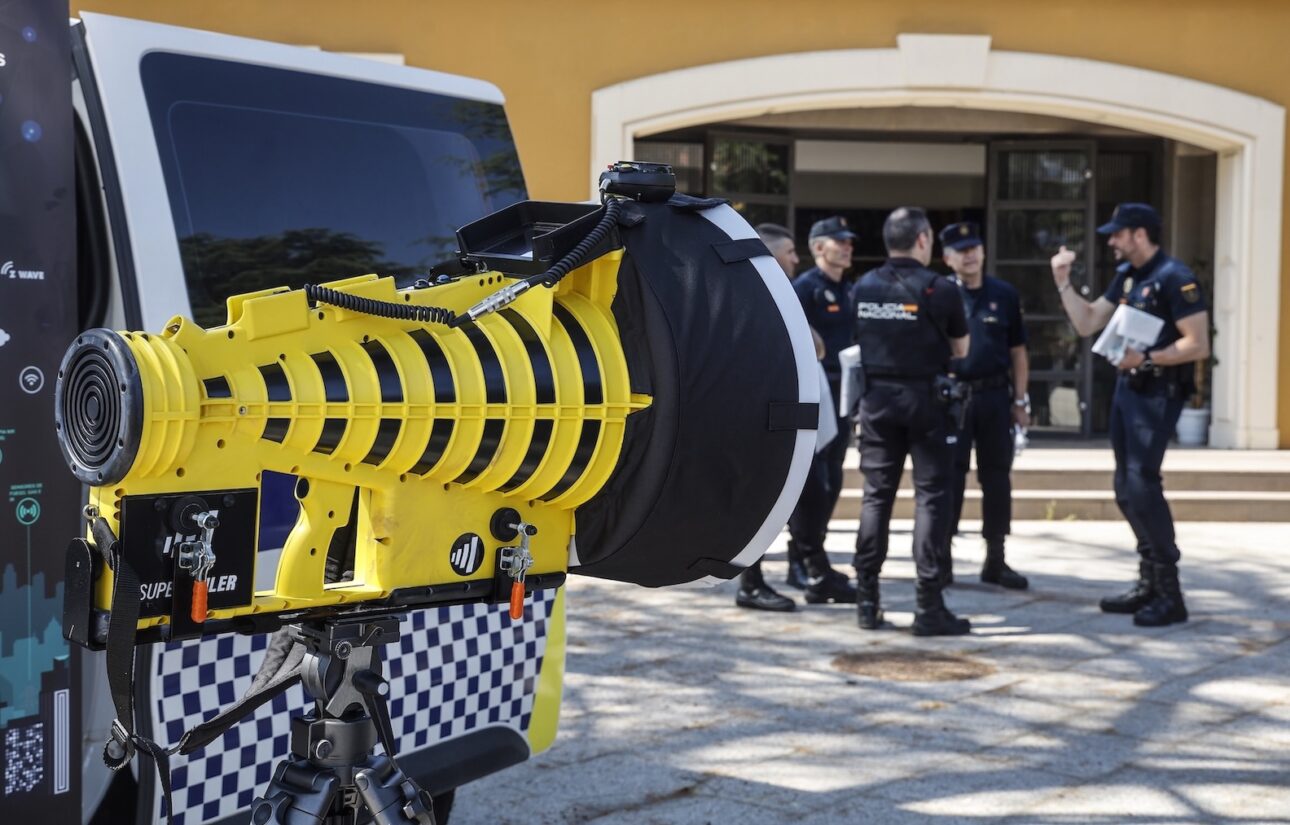
Cancian says LRADs are about a yard across and look like a DISH antenna. Those in charge use a handful of these sonic cannons for quick, maximum effect. “It is extremely loud. They push you to get out of the way of the sound.”
As far as deterrents go, Cancian states that the U.S. military has a “directorate for non-lethal weapons” at the Marine Corps base in Quantico, Virginia, and have been developing a wide variety of items for crowd control, for use on the sea and on the ground.
Cancian says that LRADs were created as tools on the scale in between riot gear and lethal force. “It does something similar to what tear gas does—it makes people back off, and disperse without violence, without the physical effects of tear gas… It is a useful tool, a useful crowd control device.”
Useful in that a blasted-out eardrum beats a billy club, maybe, but are LRADs ethical? Getting hit by the wail of a sonic cannon is better than getting hit in the head by a bullet, but does that make it right?
Brian House, a one-time associate scholar at Columbia University’s Center for Spatial Research and currently assistant professor of art at Amherst College, has his own opinions of God’s voice when it comes to crowd control. Brian has written peer-reviewed papers called “Infrasound and the Planetary Imaginary” and “Urban Intonation: Listening to the Rats of NYC,” and further scientific investigations on the rhythms of human and nonhuman systems, and subversive technology, and developed macrophones, which study sound below the range of hearing.

“My research is about the nature of sound, and how that is mediated through technology,” he says of atmospheric infrasound and how people relate to the planet and elements of climate change.
His understanding of the technology of LRADs says that though these sonic cannons are “speakers, they are not conventional speakers.”
Instead, LRADs are more like piezoelectric devices, akin to children’s toys with mechanized beats or greeting cards that play tunes. There are little metal and ceramic discs inside to create sound. Because of the properties of those materials, when you put an electric charge through it, it flexes and becomes a speaker. LRADs use that same principle, but with a TON of those piezos. “Rather than one big membrane pushing the air, its scores of piezos all work together – do that and they control how sound waves come out… which makes it more directional,” says Brian.
And way more forceful. “160+ decibels is very dangerously loud,” he says. “Anything over 75db is uncomfortable. LRADs disrupt the function of the inner ear. The inner ear is more than about hearing. It is about balance, about being able to move normally through the world. If that is affected by a loud sound, it causes dizziness, disorientation, migraine headaches, and can potentially cause permanent damage.”
House says that what is being taken advantage of here is the public’s ignorance around the use of these sonic cannons.
“Sound is mysterious and invisible,” House says. “We don’t have an historical awareness of sound as a weapon. While tear gas might have certain physically violent connotations that show up in photographs or video, sound does not.
“It’s not a sound; it is energy at a dangerous frequency. Sound has many beautiful uses within the public space in terms of music or people gathering and making their voices heard. LRADs are not one of them. This is not benign crowd dispersal, crowd management, or one of those other softer terms. LRADs are a weapon and must be understood as such.”

