
Sleaford Mods’ Jason Williamson strides back and forth on a bare stage: no backdrop, no instruments, no visuals. He’s wearing his “at home” clothes, his hands planted on his hips or behind his back in his version of a runway pose. He shouts into the microphone like he’s possessed, like he’s struggling with severe mental illness. But when you start catching fragments of what he’s shouting—delivered in a spoken-word/rapping style that’s part Johnny Rotten, part The Streets—it becomes clear he’s not unraveling. He’s a genius. It’s riveting to watch.
Off to one side, his cohort Andrew Fearn stands at a folding table in shorts, a T-shirt, and a baseball cap, triggering backing tracks from a laptop. The beats are experimental, inventive, rooted in hip-hop and trip hop. Once he hits play, Fearn turns into a manic hype man, dancing in place like he’s stuck in the front row of his own show. His fingers stab the air, his legs kick out frantically, and his formidable beard does nothing to hide the fact that he’s singing along. The combination is engrossing—and genuinely funny.
That was almost four years ago. In December 2025, Jason sits across from me on a video call, friendly and engaged. Behind him is a cluster of framed items, distracting enough that he comments on them. His wife suggested he put things on the wall if he was going to spend so much time on video calls in this room. He points them out one by one: his children’s first pairs of shoes, a Yoko Ono print, a Sleaford Mods magazine cover (“We never get magazine covers—ever”), and an Ivor Novello nomination for Best Album for 2021’s Spare Ribs.
Not one to look back, Jason is ready to talk about Sleaford Mods’ new studio album, their eighth, The Demise of Planet X. The record marks a move forward for a duo who have historically kept their work in-house, recording at their studio in Nottingham, their hometown in England’s Midlands. This time, they worked partly at Abbey Road in London and at Invada Studios in Bristol, home to Portishead’s Geoff Barrow. The idea was to take some of the engineering load off Andrew so he could focus on production—though, as Jason notes, Andrew often ends up re-engineering the material once they’re back home—and to bring in some fresh energy.
“One or two ideas fall from the sky every four or five months, so over two years, you’ll get four or five songs, and the rest is built around the style of those, or it’s just improvisation in the studio,” says Jason. “A lot of the lyrics are personal, but I’m gatekeeping myself almost, thinking I can’t say that because I’ve said it before. It’s finding different ways of saying the same thing, as Paul Weller once said. But there’s always new subjects that come up. I find it really inspiring how people react to narratives. The levels of stupidness that come out can fall into a melting pot for lyrics as well.”
The Demise of Planet X features a notable run of guests: Game of Thrones actor Gwendoline Christie on “The Good Life,” Aldous Harding on “Elitest G.O.A.T.,” Sue Tompkins of Life Without Buildings on “No Touch,” with hometown allies Liam Bailey and Snowy appearing on “Flood the Zone” and “Kill List,” respectively. Jason sends the lyrics in advance, and the way each guest inhabits his words brings a different dimension to Sleaford Mods. “It feels like more of a broader group effort,” he says. “Most of the stuff the guests are singing are stuff that I couldn’t sing myself. It’s definitely something I’m starting to believe is an integral part of the sound now.”
Don’t expect to see the guests joining them on stage either in-person or as visuals, though. According to Jason, Sleaford Mods’ minimal setup still has a lot of vitality to it, and for him, having a lot of people on stage brings to mind the forced setting of a reality show. “It’s like ‘The Osbournes’ or something. It’s all these people milling around talking to each other. It’s just silly. It feels cluttered. There is obviously a place for traditional band formulas. I listen to so much music like that, more so than I do the music we represent. But for me personally, I can’t work that mode of that genre.”
There’s an “anti-pop” quality to The Demise of Planet X—a phrase Jason says has been used to describe it—that he associates with a sense of “lightness.” Some of that lightness comes from working on himself and exorcising certain demons, something he speaks about openly and without hesitation.
What led to your being more open on this album?
We all have to feel like we’re moving on, don’t we, especially if you’re creating things. Sometimes the process is quite unnatural. In another two years, I’ve got to write another album. The approach to the process feels almost forced. I think what displaced me was the fact that global politics has become domestic politics, has become an integrated part of what we feel is closest to us as an everyday narrative. This is no longer me sitting in the garden going, “The Conservatives are really bad, Labour are ineffective, and everybody’s just shit.” It was much more than that. It was, “What does this mean to me?” It led me into an almost existential crisis.
A lot of musicians speak publicly without a true understanding of what they’re talking about, but that’s never been my impression of you.
There are certain songs [on the album] dedicated to performative fucking nonsense. More than the invasion of Ukraine, with October 7th, people started to hemorrhage judgment in a way that felt completely unnatural and was obviously clouded by this catastrophe that was unfolding in front of us. The album is very much concerned with that mindset. It was a case of dealing with my own anger—for a long time—because I have been accused of being ineffectual or gaslighting, because of my neutral stance. Someone in an interview said, “But you’re making this about you,” and it’s like, well, yeah, because at the end of the day, that’s all I’ve got. In order to make sense of it, first I need to deal with it internally. I have anger towards other people, this short sightedness, what that meant, and how I was going to put that into songs. It was a bit of an old slog.
I appreciate your being more thoughtful about it. I rarely hear that kind of consideration from musicians.
This seems to be a trend with everybody, doesn’t it? People are more concerned with arguing with each other than they are thinking about the actual source of the trouble, of oppression, of whatever it is. There was no talk about constructive methods or unification. That’s a word I ran away from for a long time because I found it so cliché, but it’s fucking right. Without [unification], with an infestation of separatism, nobody will get anywhere—ever. It’s so easy for people to think they’re doing something for the cause by tripping other people up in arguments, rather than contributing to whatever it is that could help. The reality is, we all know there isn’t much we can do, and it makes this hemorrhaging of hatred towards people with similar beliefs even more so.
I also appreciate the resistance that you have toward getting bullied into performative activism.
People are like, “How can you be the way you are with these images on the news?” And it’s like, “How can you just adopt a narrative that is swept through the internet almost overnight without sitting back and thinking about this? Three months ago, you were not fucking bothered about the people of Palestine. You were not bothered about the situation in Gaza. You had no understanding of it, and you still don’t.” There are people out there going through things that beggars belief, but surely people would think for themselves. Then it dawned on me that most people don’t. I entered into this whole new disgust, which saddened me even more, because it made me just as bad as them. I’m being just as separatist, just as accusatory as they are.
Do you feel people will do what you did and examine within themselves?
A lot of people have invested in pro-Palestine, heavy on the genocide, and they are digging in. And for good reason. It’s not nice what has happened to the people of Palestine. But these things are so complex, and I wasn’t about to dive into something I didn’t really know that much about. I thought that would insult anybody suffering even more than me going “Way-hay!” and holding something up and running from one side of the stage to the other with no top on, kicking out the same lines.
You’re referencing your show when a keffiyeh was thrown on stage. It sounds like they were trying to provoke you.
I do regret that [keffiyeh incident]. I regret it so much. I regret the Twitter outburst after. I should have stayed on stage and finished the gig. But those images were so fresh in everyone’s mind, and it was a week after October 7th and I was watching the news daily because we were on tour in Europe. It was just such a sensitive subject and I thought to center myself in it at that point—at any point—would be a massive insult. [The keffiyeh] just kept coming back. I’m really enjoying this gig, and [the people that threw it on stage] looked absolutely battered, like they were on something. That angered me even more. A lot of these fucking musicians are totally off their heads all the time. How are you intending to free the people of Palestine with that bag of cocaine? Is that how it’s going to be done? Is it?
You don’t seem to take direct shots at other musicians anymore. What led to that change?
I don’t name people specifically. Number one, I think it’s really cheesy. And number two, it makes them look better. I’m going to insult you to the maximum, and I’m going to make it so broad that absolutely no one will know who I’m going on about. It’s as if I’ve got you in a little cage on my table, and I’m prodding you occasionally. To me, it felt better to do that than to attack people personally. It was repetitive and it was ongoing. Why am I fucking doing this to that one individual? They aren’t the problem. I think a lot of criticism is feelings of self-worth, of not being seen. I see this with other bands and solo artists. I’m thinking, “You don’t give a rat’s ass about this person. It’s more to do with you not being seen or taken seriously.” Whilst there is a case for critique—fucking without a doubt—and I will always work with it, sometimes targets aren’t necessarily about what the person is criticizing them for. It’s more to do with themselves. In that sense, it becomes stale. It feels almost pathetic. Particularly with this new album, I wanted to feel like I was writing music in line with how I was feeling.
What helped you shift into this Zen mind state?
Loads of therapy, loads of anger, loads of talking about why I’m so angry, loads of understanding it, and coming to simple conclusions that it’s all right, let’s fucking hate someone, alongside the fact that sometimes you’re hating someone is a bit more complex. I really cared what other people thought of me, and I wasn’t aware of it. Now I’m at the point where I can honestly say that I don’t care what people think. It’s taken me 55 years to get to that.
You always come across as not caring what people thought of you at all.
I couldn’t give a fuck what people thought about the music, because I knew full well that it was bulletproof. I’d spent my life, the past 25 years, trying to find a formula that was original but familiar, that had a pop structure, that had all of the things that inspired me. When I discovered Sleaford Mods, I knew it was right, so I didn’t give a shit what people thought. But after a while, critique of my moral point of view really got to me, because I knew these people were full of shit, but I couldn’t vocalize it. I realized that there’s not a lot of ways to vocalize it apart from the obvious, and that obvious will be powered by this disregard for what people think of you. It doesn’t help to cut people off entirely. If someone’s a raging fucking fascist, even people with those beliefs, you can find an accessible way to communicate, for the most part. I forgot which Specials song it is, but he invites everyone down to the gig: racists, the MP, far left, anarchists, punk, all of them are welcome, and that’s such a powerful thing. I’ve since realized that is the only way you get any sort of peace of mind. But, at the same time, I am conflicted. My thing is that I let them exist in my head. It’s almost like the safe space to be, rather than reduce them to nothing and just not think about them. It could be good for songs, but how many fucking songs do you want to write in that vein?
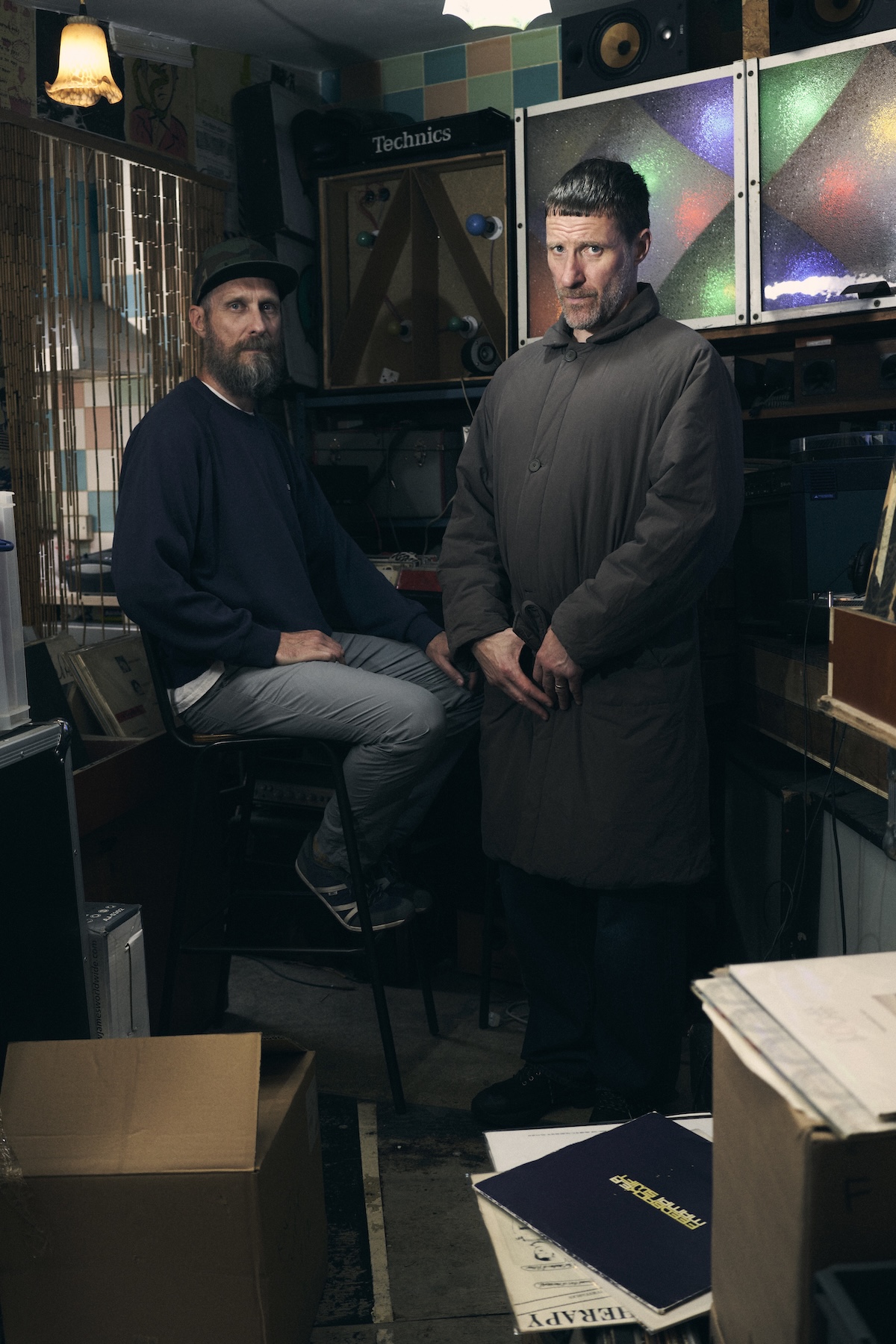
It took you a long time to get to where you are, but it seems your life experience has served you well in your creativity.
I struggled trying to get the band together. I couldn’t articulate myself in writing. I wasn’t very good with words back then, and it always hindered me. Then I discovered pornography and cocaine. I didn’t need anything else. It was fantastic and it became a massive problem. I don’t think it was purely down to the drugs and my lifestyle. I also think that I was not happy in all of the bands I was in. They all seemed quite amateurish. People seemed not into it. I tailored myself for the cause in the sense that I didn’t have any children, I didn’t get into relationships that were going to become bigger than what I wanted to do with my life. I was almost like an incel, dedicated to the cause, and I was ready to go at any time. I found all of these other acts I was in lackluster or that their aesthetic wasn’t original. Originality meant a lot to me. I know that’s not the answer, but you know, in the landscape I was in of Britpop, of fucking dirge, it occurred to me that electronic music was the way out of this, so I started doing more with that. But generally speaking, I always felt like I was being held back, not only by other people, but by my own middle of the road ideas. They were terrible. Why am I so shit? All of these people I’ve been massively inspired by, why am I not doing something like that? I was fortunate enough to come across my eureka moment eventually.

