
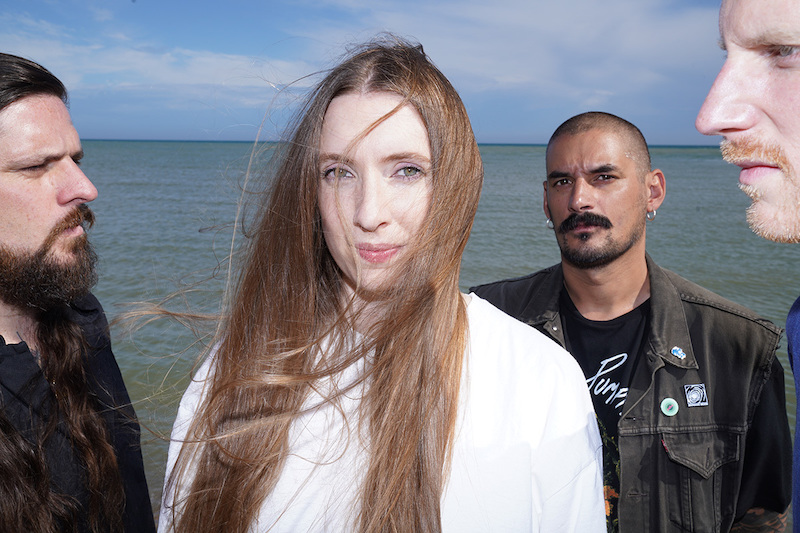
Dry Cleaning singer Florence Shaw likes to keep some distance between her vocals and the rest of the band. Shaw’s curious confidences, spoken-word confessions, and bemused monologues appear to have only a passing relationship to the propulsive rhythms and brittle riffs that frame them. That dissonance can be striking at first, but it grows restrictive–stark contrast can only take you so far.
For their third album, the British quartet escapes the narrow confines of their style, in ways both expected—increased use of melody in both the vocals and instrumentation—and surprising, by pushing detachment even further. “Cruise Ship Designer” focuses on alienation, with Shaw assuming an identity that’s not only separate from the music (chiming arpeggios and a crisp tempo) surrounding it but is actively estranged from the concept of song itself. Lyrically, Shaw assumes the identity of a male naval architect discussing the vagaries of the ocean liner trade. “I don’t personally like them, but I need to have a useful purpose,” Shaw tells us, alternating this deprecation with blunt braggadocio: “A powerful boat for a powerful mind.” Shaw has always used her frontperson position as a vehicle for performing specific and ever-shifting roles, but here she moves beyond the merely theatrical. Whatever the boatbuilder is trying to tell us , you get the feeling that it shouldn’t—and maybe can’t—be communicated via music. “I make sure there are hidden messages in my work,” the song concludes, in perhaps the album’s most intriguing moment.
It’s a boldly artificial move that makes some of the other tracks seem less daring. A line like “But I don’t like to clean, I find cleaning demeaning,” from the charmingly mechanical “My Soul / Half Pint” would be an arch bit of meta-commentary on an earlier album, but after the weird dislocation of “Cruise Ship Designer” it feels like yesterday’s news. At least it’s delivered in a deliciously clipped coo, a splash of sung color that’s part of Secret Love’s secret. Similar bright spots enliven Dry Cleaning’s usual streamlined aridity throughout: The vibraphone-like keyboard on the otherwise austere “Blood,” the glistening sax that adds neon luster to the surprisingly clean six-string twinkle of “Let Me Grow and You’ll See the Fruit,” the way Shaw periodically slides from stiff narration to a more lilting, flexible cadence. Producer Cate Le Bon, who last year produced Horsegirl’s Phonetics On and On, knows how to expand the horizons of monochromatic post-punk bands, and she gives the songs on Secret Love a greater depth and heft than Dry Cleaning’s previous work, which tended toward the tinny. Though Le Bon has added nuance, she hasn’t softened anything—the melted, malevolent blues of “Evil Evil Idiot” ranks among the band’s most gleefully serrated and surprising efforts.Opening track “Hit My Head All Day” showcases Dry Cleaning’s broadened palette, mixing Nick Buxton’s prominent hand percussion with programmed beats (some by Le Bon), Lewis Maynard’s lurching bass, and Tom Dowse’s warped, deliquescent guitar hooks. Elements of the band’s basic New Order-meets-Wire approach remain, but they’ve been heavily fortified by the gritty shimmy of no wave bands like ESG and Liquid Liquid. Standouts like “Hit My Head All Day” and “Cruise Ship Designer” set a precedent that the rest of the album never quite lives up to, but Secret Love, in its own way, is about variety, not consistency. If Dry Cleaning once generated most of their sparks from the friction between Shaw’s aloof reports and the sharp tumble of the music, now they get their power via the vivid array of different, often clashing but curiously connected worlds they can create.

