

Horror Show is a new series uncovering the stories of artists’ experiences with the supernatural, paranormal, and unexplained—and how surviving it provided new appreciation for creating in the here and now.
For many generations, the family of filmmakers Ximena and Eduardo García Lecuona has experienced a long-running phenomenon: When it’s your time to leave this world, you’ll get a phone call from a family member that previously died.
“My grandmother got a call from her mother, and the next day she died. Right before my grandfather died, he got a call from his dead wife. When my uncle died more recently of COVID, he first had a chat with his sister who had passed. There’s actual contact with the dead … it sounds like them and you are talking,” Eduardo explained of the inexplicable tradition during a recent Zoom chat from his home in Mexico. While some might consider it a family curse, the young creative doesn’t see it that way. “For me, it’s not macabre. We all die. That’s a fact. But it’s also a reassurance that our loved ones are on the other side waiting.”
These mystical concepts of life cycles, eternity, and the permanence of loved ones permeate the siblings’ new horror film, No Me Sigas (“Don’t Follow Me”), coming to Hulu January 1. It was written by Ximena (also behind the screenplay for 2022’s YA rom-com Anything’s Possible) and co-directed by her and Eduardo. The film marks a partnership between their own production company Maligno Gorehouse and genre giants Blumhouse, marking the latter’s first original Spanish-language film.
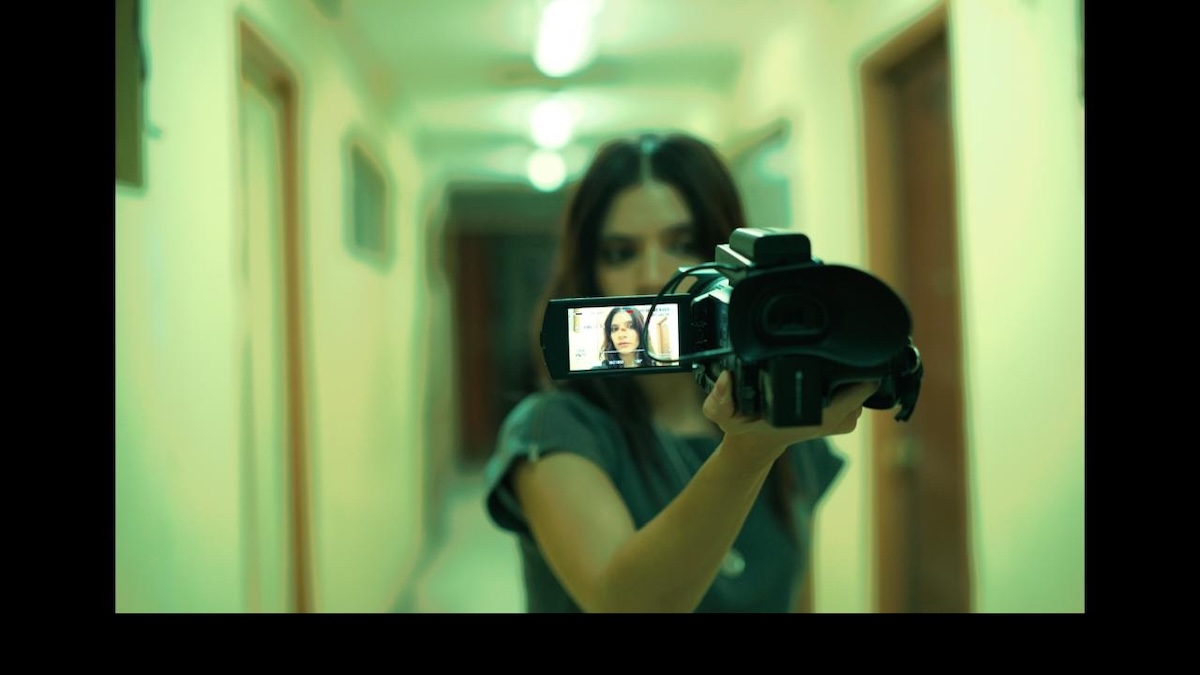
Filmed in the siblings’ home of Mexico City, the suspenseful thriller follows main character Carla (played by Karla Coronado), a 26-year-old influencer who’s trying to find a viral moment by documenting videos of ghosts and paranormal events. To further enhance her reels, Carla moves into a notoriously famous haunted building in the metropolis and pads her content with some questionable fake effects for clicks before realizing that true evil lurks inside.
“We were really inspired by all these stories of haunted buildings and haunted houses that we grew up hearing about. In the movie, Carla [fixates] on the fictional Transatlantic Building, which we meshed from a lot of these stories we heard growing up in the city,” said Eduardo. As he speaks, it’s hard to escape the night-time city scene splayed out on the large picture windows behind him, giving an eerie representation of the city’s haunted lore.
Eduardo and Ximena (who was stuck in a writer’s room for an undisclosed project and unable to be part of the conversation) had a particular spot in mind for filming No Me Sigas that they knew was haunted: a structure built in the 1950s where a once-reigning politician was murdered. (In the film, the story is changed to a murdered actress from the golden age of cinema.)
“We managed to film there for like five days; it’s where we shot all the hallway scenes,” Eduardo shared, describing the environs and the strange effects the crew experienced while on-set. “It’s a decently tall skyscraper, maybe 20 floors. On floors 1 through 8, there’s people; floors 9 through 20 are abandoned, though it does have some squatters. While we were shooting, some of the elevators stopped working, and one of the grips got stuck for a few hours. So we were like, hey, no more elevators. Let’s just do the 17 flights upstairs. It had a vibe that was energetically heavy.”
The interior of Carla’s apartment, where the bulk of the film takes place, was a separate film set that the crew arbitrarily picked out but soon realized was haunted, too. As Eduardo described the spot, “It was somebody’s grandmother’s apartment. She had died a few decades prior after a psychotic break. [The family] left the furniture from the ’60s and ’70s intact and hadn’t used the apartment in all these decades.” In fact, much of the art direction behind No Me Sigas was organically adapted from these found artifacts. One example he noted was a gruesome scene with some nails stuck on the wall that was rewritten in real-time to reflect one of their discoveries. There, too, unexplained phenomena took place during shooting.
“There was a room where me and Karla Coronado would get completely sick every time we were shooting in there. And when we left the room, we were fine. It was hard for Karla to do some [scenes] there at the end,” said Eduardo, who noted the actress tried her best to use the energy and play with it for her character. The other lead, Yankel Stevan, who plays Andres, also had something happen when he went home at night. “He saw this kid ghost that appeared to him in his apartment building. He took a photo and it’s pretty creepy,” Eduardo shared.
Naturally, the score for No Me Sigas was important for adding a chilling ambiance and to push along the story’s suspense. The García Lecuonas hired composer Craig Davis Pinson to do the trick. Eduardo had known Pinson’s musical instincts since the two logged time in punk bands together when they were younger. In latter years, Pinson would go on to work with Chicago-based experimental noise makers Fat Pigeon and Eduardo worked with post-punk band Sacred State when he temporarily lived in Los Angeles. Ximena, too, is a part-time musician who currently plays drums in the underground band Carmen Machina.
“That really helped with talking about the music because we were all on the same page,” said Pinson during the Zoom chat. They decided the character Carla would play guitar and be a fan of Mexican post-punk (even adding a song by stalwarts Grito Exclamac!ón to the soundtrack). Pinson did attend shooting days and tried to capture sounds from the set, but none proved fruitful. Instead, he attacked the score using adjacent avant-garde techniques.
“I wanted to deconstruct the guitar into a language that’s more related to contemporary classical or abstract music, giving this kind of supernatural feeling that goes beyond the present,” said Pinson, inspired by the scores Colin Stetson created for Hereditary and Mica Levi composed for Under the Skin. To accomplish the effect, Pinson put vibrating sex toys on the guitar pickups and used just intonation tunings. “It’s like a primordial resonance that’s in nature and if you hear classical instruments played in these tunings, there’s something really arcane. It sounds almost religious and old and ancient.”
Pinson also relied on a retro vintage Italian toy organ called the Bontempi B1, which he picked up at a historic flea market in Mexico City called La Lagunilla. “That flea market also has a lot of history and roots back in pre-Hispanic times. It’s a very strong cultural place where you buy used things. It gave that sense of place to reflect the found objects from the physical locations of the film, and tied back into Mexico’s very spiritual and very haunted history.”
Knowing how much deep spiritual history they were tinkering with, Eduardo and Ximena consulted curanderos, or healers, who did pre- and post-filming rituals to protect everyone in the crew. “It was eight hours of offerings to pre-Hispanic deities,” Eduardo noted. The rituals took place on Tepeyac Hill in the center of Mexico City where it’s said the Virgin Mary appeared to a now canonized indigenous man, Juan Diego, in 1531 during a time of colonial occupation. “In Mexican Catholicism, it’s a very holy ground,” said Eduardo. Even before the Marian apparition, it was a site of worship to the Aztec goddess Tonantzin who’s connected to the goddess of fertility and creation, Xochitlicue. “So it’s a very energetically and spiritually charged place.” The healers believed portals may have been opened during the process of making No Me Sigas, but closed them through additional ceremonial rites. As Eduardo lightheartedly conceded, “The shoots went well, so I think it worked.”
Consulting modern healers is something natural to the García Lecuona clan. Their grandmother practiced witchcraft and many members of their family are proponents of syncretism, “a meeting of pre-Hispanic shamanism with Catholic sensibilities and icons,” explained Eduardo. “We grew up with that and it got us interested in the paranormal, but it also kind of made us normalize it. With No Me Sigas, the ghost relates to love and family. And I think in a way the ghost stories we grew up with weren’t creepy, they were just fact.”
It’s a tenet that is shaping the siblings’ next, as-yet-unannounced film project. “We want to work from the angle where sometimes the ghosts and the witches and the rituals, they’re not the villain, but ways to face your monsters and your own fears,” said Eduardo, whose ultimate mission is to take Latin and Hispanic traditions and horror stories to the rest of the world. “In our Hispanic culture where we grew up with the paranormal in everyday life, we want to make horror where those are tools for the heroes and not necessarily the things we fight against.”
No Me Sigas is available for streaming on Hulu starting January 1

