

Stepping onto Azam Ali’s property in Glendale, located in northeast Los Angeles County, is like entering the titular space in Frances Hodgson Burnett’s classic novel, The Secret Garden. Despite cars rushing by faster than the speed limit, the foliage surrounding Azam’s home acts as a sound barrier that makes me want to be ultra-quiet. The classic Spanish-style house is tightly locked up, but then Azam texts me to come around the side where she throws open the wooden door then throws open her arms to welcome me in.
Everything about her is flowy: her dark wavy hair, her black floor-length dress and accompanying wrap, her pewter-toned bohemian jewelry. We climb the stairs to her home studio, which is clearly a hideaway. Velvet furniture, deep rich window treatments, acoustic panels covered in what looks like mosque partitions, string instruments on walls and stands ring the room, plus keyboards, effects racks, and speakers on stands all evoke a creative sanctuary. The computer disappears into the background in this textural room.
In the middle, on a small, round mosaic-topped table, Azam has laid out a mini-feast of home cooked Iranian food. She insists that I “eat, eat!” as is the way with our people. I take a bite and it’s absolutely delicious. She serves fragrant cardamom tea that sparks memories of Friday visits to my great uncle many years ago.
Azam, and this sacred space, look like her music sounds. She has just released her latest solo album, Synesthesia, which gives me the same sense of calm as being around her does. Written, produced, and performed by Azam (with some instrumentation from her husband and their son), emotional electronica is the catch-all term I’m using for Synesthesia. The lyrics are minimal, but poetic and visually charged with nature-based imagery and metaphors. Propelled by her exquisite voice, strong and sensitive at the same time, the music shudders and breaks, exposing fear, isolation, sorrow, but also determination and redemption. She includes two wholly original covers: Tim Buckley’s “Song to the Siren” and Natalie Merchant’s “This House is on Fire.”
Synesthesia is her sixth solo album, but over the last three decades, Azam has released a lot of music and earned two Juno nominations. She’s recorded with her and her husband Ramin Torkian’s acoustic electronic band Niyaz, the alternative world music project Vas, and the duo Roseland. Additionally, she’s collaborated with composers providing vocals for film, TV, and video game scores, among them, Fight Club, “True Blood,” Call of Duty, and Prince of Persia: The Forgotten Sands. “There are so many different personas that live inside me. I believe that about everyone,” she says.
But her origin story, which unfolds like a generational family saga, began a long time ago when her mother found herself pregnant after Azam’s father left her. A single woman of Bahá’i faith, persecuted in Iran even before the Islamic Revolution, for Azam’s safety her mother sent her to an English boarding school in India set up by the owner of the prestigious hospital where she worked as a nurse. Azam was 4 years old. She stayed there for 11 years and wasn’t able to see her mother for an eight-year stretch due to a variety of familial and political reasons.
I can tell Azam isn’t keen to give me all the personal details of her early life, but I insist on explanations for inconsistencies in her timeline. She hesitates, but starts filling in the gaps, avoiding eye contact for the most part. I recognize this trait as it is one I share when I’m talking about topics I would rather not. When she holds forth, her speech is filled with unintentional pull-quotes, and when it’s all out, she says, “I was loved. I had a good education. I made very good friends. We’re dispersed all around the world, but to this day, we stay in touch.”
Music had already stamped itself on Azam during her boarding school years. One of the course requirements was classical Indian dance accompanied by a singer and a percussionist. Azam was distracted from the steps as she was immersed in the music. Even the chimes of the temple bells carrying through the valley where the boarding school was located would affect her. Tapes of popular Iranian singer Hayedeh and folk favorite Sima Bina that her mother would bring also shaped Azam musically.
“My experience with music was always extremely intimate,” she says. “As far back as I can remember, it was never something that disappeared into the background. If there was music, it would get all my attention. When I would hear Hayedeh’s voice, it was magic, like a spell.”
She was reunited with her mother in India in 1983 when they entered a lottery for Bahá’is trapped outside Iran, offering political asylum in Australia, Canada, and the U.S.. They were picked and sent to Los Angeles as refugees in 1985.
“I had a very tumultuous relationship with my mother,” recalls Azam. “She had been absent and I had already developed so much of my own character that was outside the scope of family influence. It was a very combustive situation.”
After three years, Azam moved out and “was adopted by eight gay men.” Listening to the city’s tastemaker station KCRW, she heard A Feather on the Breath of God: Hymns and Sequences by Abbess Hildegard of Bingen by Gothic Voices and was transfixed. “It was a piece by Emily Van Evera and I couldn’t move,” she remembers. “To this day, even when I talk about it, I get goosebumps. Suddenly, it all connected. It was the same feeling as when I would hear the temple bells.
“It was culturally a totally different country, completely different context of hearing music, completely different language, melodies were different. Everything was different, but it was doing something to me. At that point I understood that music offers another reality. You’re able to travel outside of this flesh. I became obsessed with the idea of being able to make people feel the way I’m feeling, but by me creating it.”
Initially, she pursued learning a traditional Persian instrument, partly to discover the culture. She studied the santur (hammered dulcimer) for eight years. When she had to sing certain pieces, her teacher encouraged her to pursue that instead. She took a beginner voice class at Santa Monica College, where her instructor told her the same thing. She joined the choir and while singing didn’t feel like her calling, it became her calling.
“Maybe the reason playing an instrument wasn’t enough for me is because I was carrying so much trauma,” she says. “I feel like when I started singing, the voice became a conduit for all that. I was able to finally channel everything I had carried inside of me into a language that could express what I was feeling. But it was also through that language that I was able to create a transformation within myself, where you are able to transform your pain into something illuminating. That process is the gift artists have. Whether you’re a painter or a writer or musician, the fact that it resonates with people and you can create this transformation for them is nothing short of magic.”
While discovering her voice, she was also connecting with industrial, post-punk, trip hop, and film scores. She was hearing Middle Eastern sounds in industrial music and looked to combine East and West. She sees music as autobiographical and recognizes an “ethnic aesthetic” to herself that absorbs folkloric music from around the globe. She namechecks Iranian poetry, music, and spiritual traditions as key ingredients in her musical makeup. She works on music regularly—although with an 18-year-old son, her time is precious, yet when she hasn’t been in the studio, she starts unraveling and her husband sends her up here to reset by creating music, even if it is just for the sake of it.
“I have an interesting relationship with music,” she says. “It’s like a radio station. I keep turning the dial and suddenly I lock into a frequency, and something comes through. I feel the path chose me.”
Even with this undeniable pull toward creation, Azam had a difficult time reconciling the cost of making and releasing Synesthesia. Her last solo album, Phantoms (2019) cost $50,000 to mix and master as well as press CDs and vinyl, pay for publicity and marketing—and she’s not even counting the weeks and months it took her to create the album. She had a patron who covered some of the cost, but she paid the rest. After 18 solid months of promoting and touring the album, she made back a fraction of the outlay.
“At the end of experience, I realized that records are now officially very expensive business cards,” she states. “I no longer feel like I know where my place is as an artist in today’s world. So many artists that I come across now I describe as great Instagram artists. They know how to market themselves on Instagram. I’m not an Instagram artist. If I can’t make records, then what am I? I started making music with the intent that I’m never going to put music out again.”
This is a massive adjustment for Azam, who comes from the era of record deals with advances and budgets that allowed her to focus on her art and in return, sell a respectable number of albums. With her son getting ready for college, she can’t justify spending the equivalent of two years’ tuition on making an album that she says will only earn as much money from digital streaming platforms as selling four physical albums would.
She’s always been good at tapping into the patron of the arts concept. In the PledgeMusic days, she ran a very successful campaign. She references Italy and how its history of art was built on patrons. “In a capitalist society, art is the first thing to go. It’s a luxury, but it becomes a necessity and a guiding light for humanity,” she says.
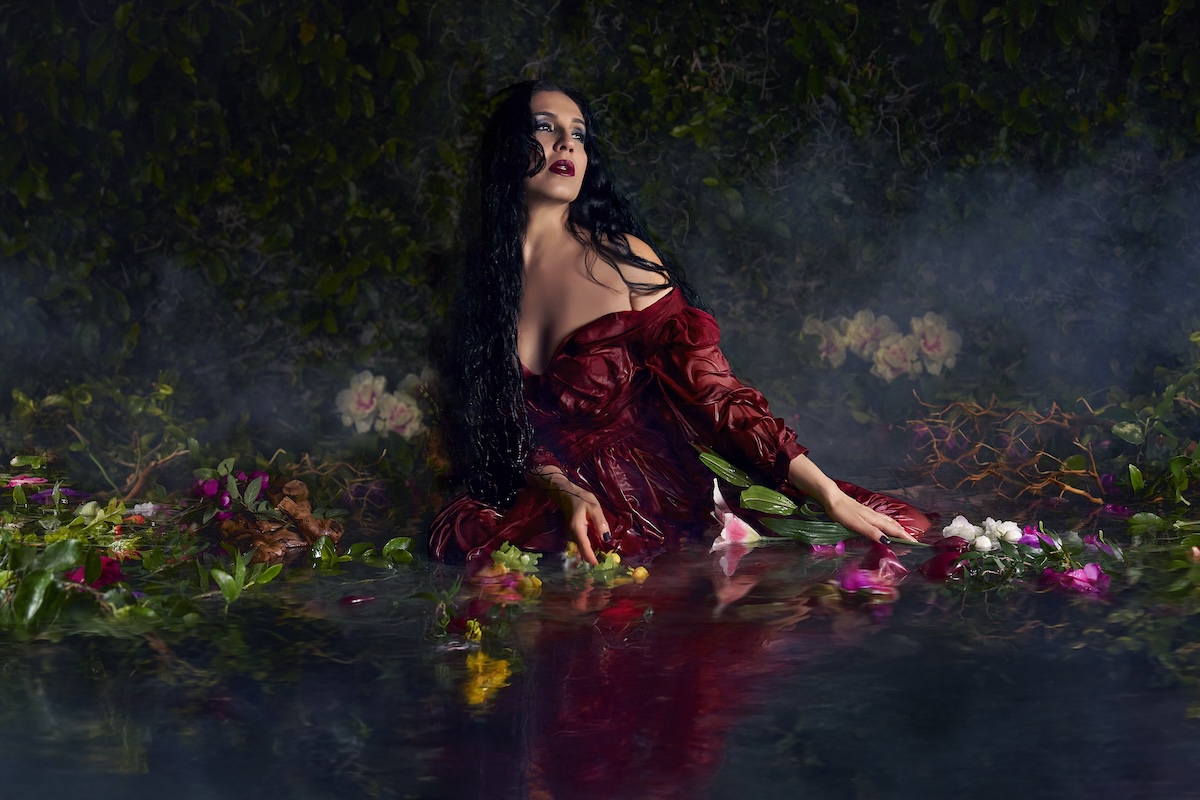
But Synesthesia, like all her previous albums, did not consciously begin as an album. She is always writing and recording, and at some point, an album reveals itself. It shaped itself over five years, the longest it’s ever taken her to complete a work. “It’s not because I’m prolific, but music is such a form of therapy for me, it’s my sanctuary,” she says. “I’m always producing and after a certain point, I feel like it’s not for me. It has to be put out there. You have to give it away.”
She played the sketches of what would eventually become Synesthesia to Christian Petke of COP International, a good friend who came to see her on a social visit. After hearing what she had, he offered to fund the recording and put out the eventual album. While knowing the album would see the light of day was motivational, the music has only ever been made for herself. “Music is so sacred for me,” she says. “It’s where I go to tell the truth. I can never lie in that space. It’s a place to pour my heart and my soul.
She continues, “But for this album, there was always a deep sadness within me thinking, ‘What’s the point of finishing it?’ It was always very sad for me when I would pull up the songs and listen to them and think, ‘Wow, this is really good, but what’s the point if I’m not going to put it out? Who am I going to finish it for?’ Having the support to do it, I’m so grateful for it now. When people write to me about their personal experiences with certain songs, it reinforces that art is for everyone. It belongs to everyone. And, as artists, we have a moral obligation to do the work.”

