
Visual artist and puppeteer Wayne White doesn’t claim to be a good musician, at least not in the traditional sense. But then again, nothing is traditional when it comes to White. And he prefers it that way.
White is a man you may not be familiar with, but his work you’ve most definitely seen. As a production designer, he’s worked on TV shows such as “Shining Time Station,” “Riders in the Sky,” “The Weird Al Show,” and “Beakman’s World.” But what he may be most famous for is his Emmy Award-winning work on the 1980s Saturday morning show “Pee Wee’s Playhouse.” He was also the art director for Peter Gabriel’s “Big Time” music video in 1986, and he designed the sets for the Smashing Pumpkins’ 1996 music video, “Tonight, Tonight.” He’s also the guy behind those Snapple commercials in the early 2000s.
Mostly, these days, White’s been spending a lot of his time creating fine art—his word paintings, sculptures, and most-famously, his giant figure installations made from cardboard, wood, and Styrofoam, which have been featured in a 382-page monograph and a documentary called Beauty is Embarrassing.
But now, he’s delving back into a whole other art form—music.
“I’m a visual artist, of course. And visual arts and music are kissing cousins,” White says. “I think all musicians should draw. And I think all artists should play music. It’s something you can’t really put into words. It’s intuitive, but something that is direct. My word paintings, they’re poems and they’re just a step away from becoming a song. And I’ve always written short poems and then used and found phrases in those poems and turned them into paintings. So I’m just kind of expanding those poems into songs.”
As of this writing, White is in his hometown of Chattanooga, Tennessee, visiting from Los Angeles, where he currently lives, to rehearse with his band, Username Password. With drummer Bob Stagner, guitarist Jim Tate, and multi-instrumentalist Bryan Dyer, White is the lead songwriter, playing a three-stringed cigar box guitar given to him by a fan at White’s book signing in Columbia, South Carolina years ago. They set up shop in Tate’s garage in Hixson, a suburban neighborhood about 10 minutes from downtown, and they invited me to sit in on their practice session.
“Playing this thing is like liberation,” White, who has played banjo since he was 16, says. “I’m not compared to all the guitar players and I’m not some boring guitar nerd. It’s a very simple way of expressing and you can get a good sound out of it.”
White considers himself near-adjacent to music, having worked in the music video business after leaving Tennessee for New York City in 1980. “See, these three guys, they have musical knowledge. I don’t,” says White, pointing to the other members of Username Password. “I’m very naive about musical knowledge and structure and stuff. I think our salvation is, we’re not coming at this from a music industry point of view at all. So that keeps us kind of fresh and clean. This is just a pure creative project for me. It’s just another art project. I’m not worried about the business at all, which ruins everything.”
This past March was a big month for the band, as Username Password played at Knoxville’s Big Ears Festival and released their debut album.
The self-titled record is a 50-track compilation of short audio vignettes. Not really songs, but under-two-minute sketches, sometimes instrumental, sometimes with vocals, about random themes and objects, with simple titles such as “REO Speedwagon Poster,” “Cuckoo,” and “Spaghetti Western.”
“I didn’t want to write love songs. I want to write songs about history and weird shit,” says White.
“I never wanted to do things regularly. I didn’t want to write a regular two-, three-minute song. I just had these short ideas and I liked them as short ideas. I was kind of inspired by Guided by Voices, I guess. The way he [Robert Pollard] just kind of rattles off one idea after the other. I like that stream of consciousness kind of songbook. I didn’t want the pressure of conventional songwriting. I just wanted freedom. “
Take the album’s 11th track, “I’m From the South,” which starts off with the faint sound of keyboards and acoustic guitar picking, as White sings in a Southern drawl, “The way you drop me off at home / On your way to the jail / The little leg stickin’ out of your mouth / Your face so pale / Cherry cough drop in your palm / In the A-frame shade / Apache pop-up, camper girl / I ain’t afraid of you / I’m from the South.”
White says the band’s sound is “a little bit of everything,” something he describes as “Appalachian soul stew,” listing blues, bluegrass, bossa nova, marching music, nursery rhymes, and punk as flavors in that stew.
“Everything but Robin Thicke,” Stagner chimes in.
White, who knows plenty of famous musicians and has one for a neighbor (he asked me not to namedrop, so I won’t reveal who) prefers to play with his hometown buddies.
“In my long history as a music hobbyist, I was always meeting musicians who had no patience with me because I wasn’t quite good enough, or I didn’t meet their conventional sense of song structure and everything,” he says. “I just wanted to play and explore in a kind of loosey-goosey way. And I was lucky enough to meet these two guys who were pros (pointing at Tate and Stagner) and of course, Bryan, too, that had the same kind of imagination that I have, and the same kind of open-mindedness and tolerance of someone who’s not a professional musician, who isn’t structured like a regular musician, who just wants to play.”
Username Password came together over a matter of years. Stagner and White met in 2008, when White was in Chattanooga promoting his book. Stagner was with his childhood friend, Dennis Palmer—who passed away in 2013—with whom Stagner founded the acclaimed free improvisation group, the Shaking Ray Levis, in 1986. The three began playing together and came up with the idea of White’s massive Chattanooga-centric art installation, Wayne-O-Rama, which ran from 2016 to 2017. Dyer, who works in construction as a carpenter, designer, and sculptor, was hired to help White and Stagner build it.
White, Stagner, and Dyer began performing shows at Wayne-O-Rama as a trio.
“We were the Belt Whooping Boys from Genitalia, Georgia,” says White.
“That’s right. You better write that down,” Stagner says to me. “l’ll never forget that one.”
Tate, whom Stagner has known for more than 30 years, eventually joined the band as guitarist, producer, and sound engineer.
After COVID hit, the band continued to play together, albeit virtually. During that time, White would send videos of song ideas to his bandmates, coming into town every so often to rehearse and write more material together, culminating in, as Tate describes it, “a bunch of kids in a room that didn’t get along, necessarily.” Fifty of them, in fact. The group of songs had no flow to them, no theme uniting them together.
“I can remember when Wayne would send in one of the songs, I’d be walking around my backyard going, oh my God, what are we gonna do?” says Stagner. “You know, ‘a boiled egg and a paper bag.’ Oh God. ‘A porn poster.’ Oh God.”
“It was hell,” says Tate. “I really thought, if we just put all these together, they’re going to sound like a bunch of mismatched kids. And I want to tie them all together…I want to weave them together.”
Tate, along with Stagner, worked to alleviate the sonic complications, and, after much deliberation, arranged five of the tracks in a somewhat cohesive order, with Tate writing additional music to help with fluidity. Once he shared the finished product with Stagner, Tate says he went to work on the rest of the album.
“I think then I locked myself down here for like three months and went a little nuts,” he says. “It was heavy.” Tate would start at 8:00 a.m., and would often work for hours a day on the record, listening, adjusting. “There got to a point where I was like, okay, I know I’m onto something when I am either ready to weep, or I sit and laugh hysterically at what a ridiculous-ass thing had just been put down. And it just got better and better.”
Despite the extremely tedious process, Tate says he had a lot of fun making the album. “But it got super weird at the end,” he says. “Like, the last couple of weeks were super, super weird. I was like, either this works or it doesn’t.”
Fortunately for Tate, it worked. The rest of the band loved it.
“I was relieved somebody could do something with all that mess,” says Stagner. “I venture to say this record has long legs. And I knew it when we released it. It’s a beautiful thing. And boy, don’t we need beautiful things right now.”
At this point in the interview, Stagner notices Dyer hasn’t said much.
“Bryan, he’s been really quiet,” says Stagner.
“Bryan hasn’t said a goddamn thing,” yells White in jest.
Dyer, I should mention, is someone I’ve known for more than 20 years. He not only deejayed my wedding but he also encouraged my wife and I to move into the neighborhood we’ve lived in for 20 years. He finally speaks up.
“That’s the way I do,” he says. “That’s the way I do.”
“He’s now my collaborator on many art projects,” says White, referring to Dyer, who seems to be hiding behind his keyboards. “We did a big installation up at the Virginia Museum of Contemporary Art called ‘Monitorium.’ We did a giant parade out in Los Angeles, celebrating a hundred years of the L.A. Philharmonic.”
“We play music at those things, too,” says Dyer.
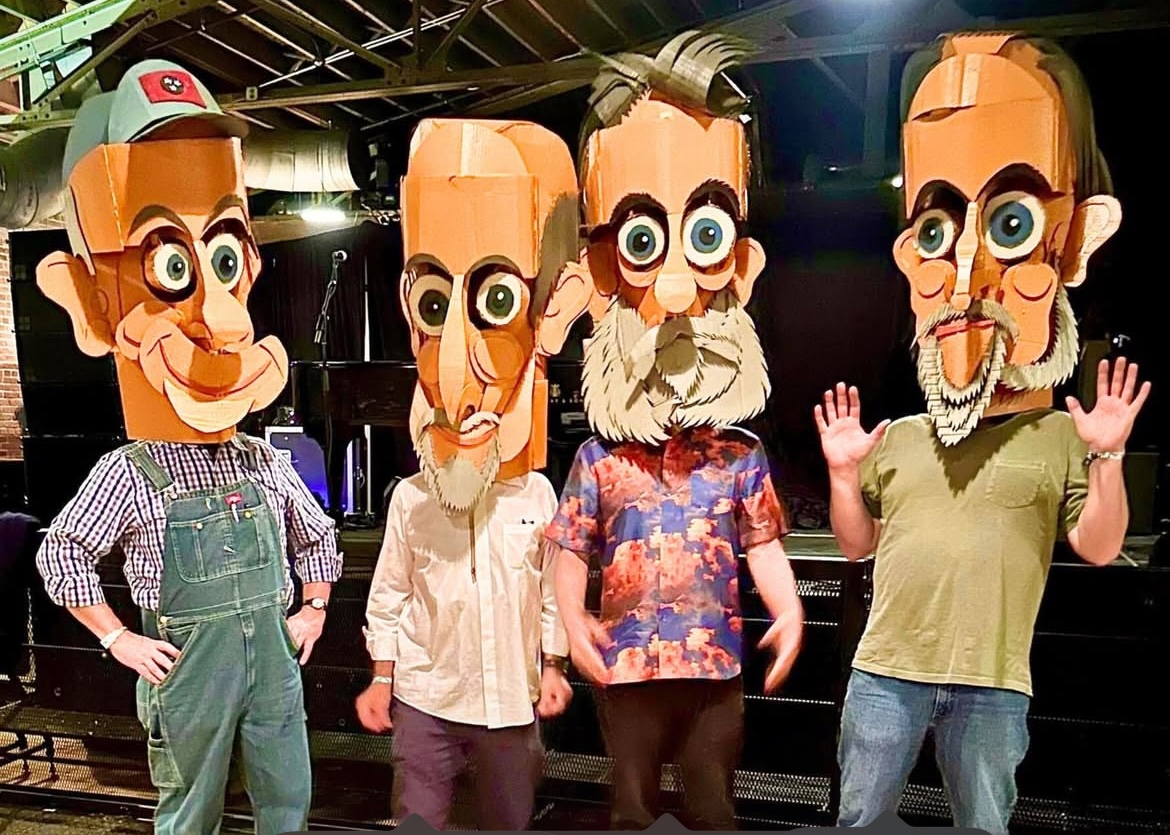
Username Password, as a matter of fact, played at White’s new art exhibition, “Wayne White: Like You Know,” on November 20 (running until January 2026) at the Country Music Hall of Fame and Museum in Nashville. And they are kicking off the 2026 Big Ears Festival and White’s new exhibit with a concert at the Knoxville Museum of Art on March 26. As they tend to do during live performances, they won’t show their actual faces. Instead, they sport oversized mask creations courtesy of White, a la Genesis-era Peter Gabriel.
As we conclude our interview, I ask White if Gabriel was an influence on that particular performance style.
“I guess if I really think about it, yeah,” he says. “I liked the spectacle of that. And I really liked what he was doing in Genesis. And then he was hot with those videos, first ‘Sledgehammer’ and then the one I worked on, ’Big Time.’ Bringing the visuals and the music together, that was very, very close to what I wanted to do with this. And I must say, he was the nicest rockstar I’ve ever worked with or met. A perfect gentleman.”
Much like White and his bandmates. Perfect gentlemen.

